Travelogue 515 – August 28
Clackety-Clack
And another one is coming. It announces itself with the same sounds as the last, the whir, the rush like wind, and the characteristic clackety-clack of the train. These are the noises of reliability. They come every few minutes, all day long.
The view out Patrick's window is of this, the curving alley of reliability, like a city canyon lined with brick. It's a river of transit, laid with four sets of tracks, and the trains that pass belong to two lines of the Tube system, the District line and the Piccadilly line.
Across the little valley, brick of sun-bleached red rises high, surmounted by ivy, like healthy green carpets flung over the walls to dry, and above the walls, rows of modest row housing in brick turning tawny yellow, surmounted themselves by the chimneys so English, long blocks made of brick and hosting a row of pipes. They look like thin legos.
This is Baron's Court, Hammersmith in West London. The high street is fifty meters to the right, outside Patrick's front door, and it looks like a village, a country stop for the train, the Tube station looking like a quaint and sleepy old station.
Close by the station is the Margravine Cemetery, a sudden peace of grass and statuary. It's been closed for business since 1951, and been designated by the council as a 'Garden of Rest'. It's main utility now seems to be providing a quiet shortcut between neighborhoods. People bow their heads in preoccupation as they stride forward, heading for the Tube Station.
I'm in London only for a day. It will be a day of meetings. The meetings will take place in South London, in the shadow of London's most talked-about new building, called the Shard. I saw it from the plane, casting its shadow over the borough of Southwark, the neighborhood on the south bank of the city, the borough that hosts the Globe and the Tate Modern, Borough Market and the ancient, flint-faced cathedral, one of my favorites. And I shouldn't forget the Golden Hinde, a replica of Drake's ship – very fun.
The Shard, as one might predict from the name, looks like a sharp bit of glass, like a spike, driven from below through the surface of the city, thrusting its acute angles high into the sky. From the plane, one sees just how high, challenging the skyscrapers of the City, the financial district of London just across the river, seeming to stand in particular contrast to the plummy Gherkin there. One nice touch to the Shard's design is the unfinished, skeletal touch at the top, tugging perhaps at our cinematic imagination, our obsession with post-apocalyptic stories, to suggest the end of civilization, even as it stands tall as a testament to our sophistication, perhaps as memento mori.
The several blocks around Pete's office, though, seem to have taken a pass on any of the romance of the district, preferring to keep their heads down, among the modest and the small, the tired brick in low-roofed structures, like warrens built in and around the elevated railway lines that traverse the borough, century-old viaducts, like sooty Victorian walls against the barbarians.
Clickety-clack, the train runs overhead. One looks up from one's reveries, catches a glimpse of the severe, Babel-like silhouette of the Shard before turning the corner. One returns to the dream. It was a dream of sleeping on the District line, exhausted body abandoned to the rhythm of the tracks, passing by one village after another of London.
Thursday, August 22, 2013
Travelogue 514 – August 22
Still Waters
There are worse places to spend an hour waiting. This is a wide hall placed at a back corner of Rotterdam's Stadhuis, or City Hall. It's where one must 'register', a distinctly European ritual. One must attest to one's existence. One must have an address. Behind the address must be a real person, the landlord, with identification numbers and documents. Once one has accepted the imprint of the state's identifiers, he or she suddenly has substance, is seen and recognized on the sidewalks and shops of Holland. I say shops because without an address, one has no right to a bank account, and without a bank account, one has a hard time paying bills. One cannot have a social security number, and one cannot work. And so all is wound together in a tight net.
If the kind reader thinks finding an address is an easy solution to non-existence, I gently advise him to think again. The formula for an address is Europe is alchemy. How does one, for example, pay a deposit on a flat should one not have earned the right to a bank account. Et cetera. These are the mundane challenges of people like us, the ghosts of Europe. One must know people. The ghost must join hands with flesh and blood. One must ask for help from the living and the identified. It's a sweet lesson in life.
But one does have the consolation of the quiet hall at the back of the Stadhuis, where one approaches the gatekeepers at the archives of citizenship. The pillars in this hall are granite. The arches and walls are brick, and much of the ceiling is an atrium of tinted and stained glass, arching overhead and admitting light for the filling in of forms. There is a border of terra cotta tiles running the perimeter of the room just above the height of the arches. Each tile articulates some analogy or theme. They also are dotted with glossy little daisies. The one I keep staring at during the wait depicts Cupid squeezing two big hearts, one in each arm.
We are called. We approach the window. We are met by the bland and round face of a functionary, his gaze inside the thick glasses directed away toward nowhere. We present our papers. Fortunately, we have a representative from Menna's school behind us, ready to translate when the paperwork does not meet exacting standards. We were presented only a week ago with forms that needed to be signed by our landlord. Our landlord is on vacation. It's August. Who is left in town to sign forms in August? Our landlord is a nice guy. He arranges to take pictures of the documents, of his signature, of hs own ID. The functionary will pause over these. The school official will step up, and lead with gentle words.
To celebrate the day's triumph – admittedly an abstract sort of victory, the submission of papers – Menna and I cycle into town after dinner. Menna has been making a serious study of the bicycle, and doing very well at it. Only a month or so ago, I was holding her up on the cycle, and running alongside her as she gets a feeling for the launch, for the tricky balance on two wheels. In the next stage, she took a number of spills, banging up her shins. We took pictures of the multiple bruises. She wants to show family. Now she coasts along on her white bicycle with the basket in front, and the town is her own.
At the Wester Paviljoen, we find Ato Moges. Ato Moges is often at the Wester. He has been coming to the Wester since his days as a university student some thirty years ago. We invite our new friend to play some cards and he agrees, though with reservations. He feels a fatherly duty toward Menna, and reminds her that card games are a distraction. She won't be able to do this once school starts. But once we have acknowledged the moral peril, the game unfolds genially. He takes an early leading the score, laughing and teasing us about our poor card skills. We order Ato Moges another biertje.
On the ride home, we remark on the quietness over the water of the canal near home. The Dutch winds have been so calm, the evenings so peaceful. Coasting without pedaling, watching the still water, it feels like I'm not moving at all. And I'm wondering if this still moment isn't an arrival of sorts. I've lived off of the thin gruel of goals for so long, always working toward something, always pedaling, I may have forgotten what it feels like to be somewhere. We just wanted a home.
Its a simple snapshot, isn't it, the water and the city and the night sky, the water so peaceful and the sky so quiet, like the elements are all in acceptance. The water takes the sky. The sky takes the city. This will be a mess for the paper men at the Stadhuis.
Thursday, August 08, 2013
Travelogue 513 – August 8
The Seine at Night
Now we're going to walk. We've had dinner, and not just any dinner. It's Menna's golden birthday, and we have dined at a restaurant that served the Obamas in 2009, a restaurant a short walk from the Eiffel Tower in the San Germain district of Paris. We have taken our sweet time at our outdoor table, savoring every bit of the food and the place, and of the red and redolent Brouilly. Regarding the food, I would need Carolyn's commentary. I can barely pronounce the names of it – there was a terrine and a foie gras, I know – but the flavors were magnifique.
The place was humble in its furnishings. One's only clue to its status in the world of restaurants would be the insolence of the waiters – we are giggling and apologetic. The setting is not at all dramatic. The restaurant occupies one corner of a very small square. The square has an odd, sculpted centerpiece that must have once been a fountain. Our table is underneath one arch of the little peristyle that runs around the pretty little piazza. Across the street are buildings not unusual, but beautiful, in the Parisian style, with ironwork balconies, gold and cream stone turned out in layer upon layer of neo-Classical ornamentation, and up high the green Mansard roofs.
We have shared a bottle of the Brouilly, and have entered the silly part of the evening. Menna is making videos of our crumbs, of the wine glasses, and of me paying the bill, with grim determination on my face. The sun has begun to set.
Now we're going to walk. Our days in Paris are long walks. Our hotel is within sight of the Moulin Rouge. Once we get going in the morning, we walk across the boulevard and up the hill, looking for good pastries. We like climbing the heights. The up keeps going up past the Moulin Rouge, well past the beautiful cafes and the beautiful people along the Rue des Abbesses, until we see the moulin that presumably inspired the satire of the Rouge, the Moulin de la Galette, site of one of my favorite Renoirs, which we see in the Musee d'Orsay. And still there is some up, until one reaches the steep white dome of Sacre Coeur, calmly overlooking its stunning prospect of the city. Menna tests the panorama function on her new camera.
We've climbed the Eiffel Tower, at least to the second floor, climbing the stairs inside one of its legs, following the crowds in single file, sweating and wishing we had gotten here early enough to find a sane line waiting for the elevators. We settle for the stairs line, which is only 45 minutes. The view from the second level is amazing. We walk around to each corner. Menna has the camera pasted to her face. We wonder what the view from the top could be like. Would we see Rotterdam?
We will climb to the Pantheon, on a day that could be the hottest of all. We'll have to stop in a series of cafes to regroup, to wipe the sweat from our brows and rehydrate. We will have set out from the left bank of the Seine, reluctant to leave the grand Musee d'Orsay, pausing to admire Notre Dame again, and then heading south. Even as the afternoon wanes, the heat will not relent. The Pantheon stands silently on its hilltop, surrounded in its circle of broad streets by solemn university halls, scarred by scaffolding but maintaining its dignity despite the rude restoration, and despite the dearth of tourists in this exhausting heat.
But tonight, the heat has abated. Tonight it's the valley we follow, the ease of the river banks. The City of Light has been ignited. Across the Seine, some building is awash in twinkling lights, and we stand at the wall above the bank mystified. Maybe it's the wine, but the lights seem somehow impossible. What is that? We turn back to our promenade, swaying and laughing and stopping to overlook the river and its doings. People are gathering along the banks, sitting by the water with bottles of wine, having picnics, making little parties. We make it to the Pont Alexandre III, turn-of-the-century beaux-arts beauty, and Menna pauses to have a heart-to-heart with one of the enormous cherubs there, whose smiling mouth is a little agape, as though he is absorbed in Menna's confidences. She tells him to remember her, and he nods in that way that statues have. His blank eyes glint in a sly way. You'll be back, he's saying without words. We'll talk again.
We stop in the middle of the span, dazzled again by the sight of the Eiffel Tower. It has begin to sparkle with a light show of its own. I hadn't known there were lights that powerful. It twinkles with Christmas-like cheer and color. And it stops. We look at each other in wonder. We ask the cherub at the other end of the bridge, 'Does that happen every night?' This little angel is going to keep his counsel.
By the time we reach the Grand Palais, my stomach is roiling. Tonight's rich cuisine has triggered some sympathetic residue of Addis Ababa in my gut. I sit in the shadow of the great edifice, built to celebrate Paris's grandeur at the end of a dramatic century, a century that had begun under the reign of the first Napoleon; a fortuitous moment before France is forced to leave behind the concept of grandeur forever, before being forced to steer between the treacherous pillars of fascism and existentialism. The cherubs still frolic.
I sit in the shadow of empire, on a cold step leading into the palais, leaning over the pain in my stomach. I sit in the shadow of Paris in heat, wrestling with the chilling legacies of travel. In time, the tremors in my gut relent, and the night becomes quiet again. We rest; we wait. We look into the stars above the sand castles.
Wednesday, August 07, 2013
Travelogue 512 – August 7
The Case for Hands
Part Three
' … and after all, you're my wonderwall.'
What is a wonderwall, I wonder yet again. Our pub singer pitches it out to us with such confidence, because someone else wrote it, and because the song is an anthem. There are a couple of Americans sitting at a table underneath the stage, and they're singing along as they raise their beers. Their smiles say, 'I'm in Antwerp, and I'm singing Wonderwall.' Maybe it's relief. Maybe it is wonder. The American singer is relieved to have a few fans for the night. 'Thank you, everyone!' He waves his right hand, as though to a stadium crowd, his left hand preserving a chord on the guitar.
'I've been proud,' Chuchu says. He is telling of his first year in Belgium. He has taken a certification course with some major computer company. A recruiter comes around, looking to fill a job that many in the class feel beneath their skills. Chuchu and another student decide to apply, a bird in the hand and all. The white student gets the job, and Chuchu doesn't. His instructor explains why. 'This job is for a field technician. You're going to people's homes.' Yes? 'Well, if they don't let you in, the company loses money.' Ah, I see. Chuchu throws it over, gets a job in a restaurant. 'I've been proud,' he laments.
Pride and some steady hands build many things. In the sixteenth century, the proud hands of the butcher's union erected a structure very near to the Steen and near to the Scheldt, a sturdy, and my brother thinks rather gloomy hall for their guild. To me, it looks like a Romanesque church from Pisa or Florence, layered brick and sandstone rising in towers in the colors of bacon. The Flemish cities are hotbeds of guild activity back in the Middle Ages. The guilds are rich, and they can build towers in the colors of bacon. I like the name of the building, the Vleeshuis.
Our first tour of the city ends back in the square underneath the grand Stadhuis. The square is not a square at all, but a kind of lopsided trapezoid, surrounded by tall, gilt guild houses and houses of the rich merchants topped with ships turning in the wind. At ground level, we are offered a rich choice of venues for beer and mussels. We take an outdoor table, and we partake of a bucket of the shellfish, marveling at the city and the warm evening.
Behind us is the city's cathedral, the Cathedral of Our Lady, the largest Gothic church in the Benelux countries, representative of two centuries of construction, begun in the mid-fourteenth century. It lends some height, some drama to the scene, which hardly needs any. We have tried to enter to pay respects to Peter Paul Rubens, but it was closed for tourism.
...Maybe … you're gonna be the one that saves me …
A short history of the city: Silvius Brabo saves the hands of Antwerp by slaying the giant Antigoon. With an industry born of gratitude, the merchants and craftsmen trade and build and build, until Antwerp is one of the biggest and most sophisticated cities in Europe. They build a port and ship, making it an international business center for the centuries. The merchants and the craftsmen build their guild halls, and they teach the generations what to do with their hands. Once they are rich, they raise gilded statues to stand atop their rich homes. They lay the central square with cobblestones, and they adorn it with two huge monuments to the life secular and the life religious, asking us never to forget them. Their descendants build a fine train station to welcome strangers. They boil mussels in the square. They tell stories about their ancestors' hands. And on the sixth day, as the culmination of centuries of achievement, they build a zoo.
The zoo is located next to the train station. Right next to it: strolling among the gardens of the zoo, one sees the arches of the train sheds above, forming one wall of the expansive complex. This is one of the biggest zoos of Europe, so they say. And it does take us half a day to tour it. But then again, we are moving very slowly. So are the animals. The summer sun is beating down on the earth mercilessly, driving most mammals indoors, bipedal or quad.
The lions are panting among the grasses of their enclosure. They are the highlight for Menna. This is her first zoo, and the most important animals for her are the big cats. The lions are obliging, gazing regally over the sparse human life among the asphalt zoo pathways. It's the Bengal tigers, though, that provide some entertainment, playing in the waters of their pen, pawing at some bits of plastic floating there, tearing them with their teeth. They wish for the utile, grasping hands of the monkeys.
The zoo is my last surprise for Menna. On this trip, celebrating her golden birthday, I've managed to line up a series of fun surprises, like … Paris. Like my brother sitting in the lobby of an Antwerp hotel. His is a face she knew only from Facebook.
There's a moment in the zoo, when the heat has forced us to stop, a moment as we sit under an umbrella in the zoo cafe courtyard, when there's a sudden chill in the breeze. We look west to see that a bank of clouds has formed. We have been talking about my family, their homes, their children, their sicknesses, the passings. Now we sit quietly and anticipate the shower.
The barometers inside our heads translate into a variety of languages, including that of calendars, the language of time. They want to alert us to change. I'm confident that each of us in our silence is peering into time, gazing with the calm of lions into the future, thinking thoughts of fall and thoughts of return, perhaps imagining again that we might raise a hand against time, one of these powerful, planet-shaping hands, that we might smite the pirate, that we might consign the hand of the enemy to the waters of the river.
The rain does come, a few fat drops splashing against the pavement around us. Then there is a pause We wait. The pause continues. We check the skies. The clouds are already passing. The rain has past, left us with only the barest relief. We are back in summer. We gather hats and cameras, and we return to our tour. Autumn has been turned away.
I'm back at the Coffee Company in humble Rotterdam. The baristas are busy spinning atmosphere, their own, singing & joking for each other, fingers dancing over the tinkling cups & glasses & plates, serving, serving, and their mouths setting an entirely different rhythm. They are singing. They are whistling. This is a merry crew. The mouths of clients are the same, making the room buzz. Outside the windows of the cafe, Holland's sea clouds keep up their steady procession, harmless in the blue sky of summer, reminding some of us of the generations moving through history. Have we made our heroes proud, I wonder, with our frivolous ways? It kind of seems like it, actually. What would Silvius Brabo say to us? Maybe he would call us his wonderwall. Maybe he would order an iced coffee, and maybe he would peer out the windows at the neat rows of brick and the girls in jeans.
Tuesday, August 06, 2013
Travelogue 511 – August 6
The Case for Hands
Part Two
The Scheldt River seeks its course, neither pushing nor dallying too, too much in its easy progress toward the sea. The clean remains of Roman hands roll lazily in the currents at the bottom. They will also reach the sea in their day, sad digits of the sailors who dared to stand up to the giant of the river, the greedy giant armed with threats and the menacing cleaver.
The Scheldt River is peaceful now. We have paced its shores, or rather the high concrete banks of its shores. The broad waters wink at us, glancing wistfully at our hands set on the promenade's railings. It has seen no piracy in centuries.
Standing as a symbol of the stern vigilance that defeated the pirates, the 'Steen', or 'Stone', stands also as a symbol of Antwerp itself, placed solidly in the center of its city flag. The Steen was first built as a fortress on the shore of the life-giving river. The stones of its first walls were set in the thirteenth century, while the prettier heights belong to the era of the Stadhuis, to the prosperous Renaissance years. As the centuries passed, the fortress became a prison. Facing each other across a picturesque little raised porch inside are a heavy set of wooden doors and an elaborate stone crucifix. This is no accident, the cross being arranged for most expeditious prayers for those sentenced to death, a stop on the way to their appointment with the executioner.
We're feeling as lazy as the grey man, Scheldt. I'm more or less playing tour guide for this city I don't know, and trying to herd this afternoon's group of cats, which today includes my wife and my brother and my brother's friend. Each has a camera, and each camera has its own whispering siren call. Each of my tour group leans in toward his or her machine, receives instruction, wanders further afield, one toward the street, one toward the river, one along the base of the fortress, peeking in its windows, eyeballing its wall, as though to scale it.
Myself, I want to stand at the side of the historical waterway, historical and living, reflecting the fresh complexion of the summer sky, winking, always ready with a laughing wink at the irony.
… all the roads we have to walk are winding,
The entertainer soldiers on, commanding the tiny stage so like a pulpit in the hallowed halls of the Irish pub, describing a curious three-quarters balustraded circle around the corner at the meeting of three long chambers. It's an odd pub, laid out in what might be a crippled cruciform, only three legs to the cross, and none providing a line of sight down any of the others. We sit in what might be the nave, quaffing our 'pintjes', chatting in three languages inexpertly.
'I'm losing my English,' Chuchu is joking. He manages a restaurant, and because most of the staff are immigrants, English is the language of the work place. But it's a primitve sort of English. He demonstrates how he has to talk: 'Now sleep. Tomorrow, early, school, I go. After, work, come. Meet you, kitchen.' Each pause is dramatic, and almost every word is painted with his hands, the pillow, the watch, walking away, pointing, gathering. “I'm forgetting how to make a sentence.'
I see Chuchu as he was in 2004. He was finishing at the university. He was idealistic, sure he was going to make it in big business. And he longed to do some charity work, help children. He approached me then with a proposal for an orphanage project, ten pages of earnest language, and his manner was so deferential. He was hopeful; he was strong. It was his work more than anyone's that led to the opening of the first school.
Chuchu is in a good mood tonight, energetic though he's put in a long shift. It's the same smile as he had ten years ago, still as generous. He is laughing at himself. He doesn't drink often, so when he does, he says, the beer has a quick effect. His friends tease him about it. His wife wants a taste. Chuchu is reluctant, since she is pregnant, but he gives in. She rolls her big Ethiopian eyes.
The singer will sing 'Wonderwall' now. We all turn to watch him, feeling the awkward mix of guilt and regard one always feels for the lone, live musician. He's talented, and he has a flair to him. Without being a virtuoso, he knows his guitar. He knows how to be playful with it, strong hand playing the neck.
… and all the lights that lead us there are blinding
The place seems empty suddenly, and dim. It seems as though nobody here is Belgian. We feel the miles. Turning back to each other, and have nothing to say for a few minutes.
Monday, August 05, 2013
Travelogue 510 – August 5
The Case for Hands
Part One
I think this music was written for baristas. Their hands are busy, their minds only half busy. The music is busy, but underlying it is a kind of kindergarten refrain. Two baristas are on duty today, the brawny and personable boy with buck teeth and pale blue eyes, and the chunky young lady with multi-colored and curly hair, whose bellowing laughter registers on the wrong side of infectious. The boy is whistling to the song, to the silly piece, like a spring in a cartoon engine that keeps the whole thing running.
The barista didn't miss me. But I'm happy to say I missed my Rotterdam. It was an intense little trip we took.
'Put all those hands together, people. Please,' cries the mock-miserable performer. He's along on a tiny semi-circle of a wooden stage inside a long wooden interior. He's American; he's an African-American on a stage far from home. He's a lanky African-American in a Gatsby hat, a black man with a multi-racial repertoire: Beatles, Marley, Hendrix, Oasis. He's playing in an Irish pub in Belgium. It's Friday night, but the crowd is all outside, enjoying the long summer evening. They're sitting at tables set in rows that extend far into the brick-laid pedestrian avenue that leads on the left to Antwerp's grand central train station, built between 1895 and 1905, one of Europe's finest stations, tall and domed and inside layered with twenty kinds of marble and stone, in back the vast, arching trainshed of iron and glass
Was it paid for from King Leopold's riches? By 1905, the king has owned the Congo for decades, as citizen-imperialist, employing armies and extracting diamonds and rubber from the colony by the shipload. He brings Christianity; he brings discipline. Villages have to meet rubber quotas. If they don't meet the quotas, then villagers start losing their hands, soldiers meting out the king's justice.
Inside the pub, there are just a few of us. After each song, we clap our hands, but we aren't enough. 'This feels like a coffeehouse gig,' the performer says. We're four at our long table. One of us is Chuchu, who was one of the original Tesfa crew in Addis Ababa. He helped put together the first two schools. Then he fled Ethiopia. He has been here five years. He manages a restaurant. He joins Menna and I and his pregnant wife after work. It's already almost midnight. 'Een pintje,' Chuchu says to the waiter. The man on stage has been noodling on his guitar. Now he breaks into 'Wonder Wall'.
Today is going to be the day ...
Earlier in the week, Chuchu has taken us on a tour of downtown. We stand in front of the Stadhuis, or City Hall, built in 1564. It's a lovely bit of Flemish architecture. Flemish and Italian, I should say, all Renaissance in grey stone, all symmetry with lines of rectangular windows, while still Flemish in its gabled centerpiece. That there is a building almost five hundred years old, commanding a square lined with undeniably Flemish constructions, standing side by side, many of them old guild halls, some set with gilded statues at the top.
In front of the Stadhuis is a fountain, in the center of which stands a handsome young lad in bronze. He is holding up a giant hand, throwing it. The statue is a sentimental rendering of the legend behind the town's name. Apparently the awkward name of Antwerp has confounded more than tourists. So why not make it fun?
The naked lad in the fountain is Silvius Brabo, a Roman centurion. They say that at some time among the shadows of ancient history, there was a giant prowling the waters of the Scheldt River, demanding tolls from the sailors and merchants. If they refused to pay, the giant would take a hand and toss it into the river. The giant had the interesting name of Droun Antigoon, probably the source of some childhood trauma that forced him to act out in this cruel way. In any case, his fetish with men's hands inspired traders to call the town 'Hand Throw'. It just trips off the tongue. And the brave act of the naked lad, Brabo, led people to call the region Brabant. Need I say that scholars don't ratify this version of events?
The Scheldt River is peaceful now. We have paced its shores, or rather the high concrete banks of it shores. The broad waters wink at us, coveting our hands. It has seen no piracy in centuries. It has even had to endure the exodus of its commercial activity, as the port moved north to deeper waters, the port that made Antwerp Europe's second busiest commercial center, behind our home, old Rotterdam. Sometimes those waters long for more than domestic peace and quiet. They dream of Druon Antigoon. They miss the excitement.
Sunday, July 28, 2013
Travelogue 509 – July 28
We Marvel
The grizzly is poisoned by an unethical hunter. It will not survive. There must be consequences. Innocent men will die.
It's silly how much joy I get being out on the bicycle. Especially on a summer evening, while the sun is still up, and the shadows are getting long. Menna is riding on the bike of the bike, sitting gracefully on the luggage rack. The temperatures are perfect, cooled by a few rain fronts that have traveled through. At the moment, the skies are simple blue.
We have left for the movie early so we could do some lazy pedaling around town. We coast through the Museum Park, by the lawns, where friends are laughing together, past the rose garden. In the plaza where Menna practices riding her cycle, there is suddenly a fountain, jets of water in rows, rising from the surface of the plaza. I steer the cycle between them.
He only wants to be left alone. He is weary of life, plagued by nightmares, visited by the wife he himself killed. But they have come looking for him. That's how it is to be a Marvel hero. The wolverine is one of their most attractive entertainments, grouchy, morose, honorable. He has what moderns want, like Batman does, a shadow on his soul. They've tried with Superman, but it isn't working. They continue to project him further out into space.
The movie theater faces onto the Schouwburgplein, a spacious piazza central to the city, a favorite of teens, who set up boom boxes and break dance, who lounge on benches lining the sides of the square, who gather for impromptu music jams. They have skateboards. They turn tight circles on their compact little bicycles. The theater watches over them, a blank paternal presence, its monumental posters like eyes, but turning sight inward. See me in here, a hero. I am the Wolverine. I am breaking my bonds with a shout. I am wrathful. My claws are out.
Thursday, July 18, 2013
Travelogue 508 – July 18
Today the Sun Rises
'Could I borrow your Tyler?' he's asking me. 'Pardon?' “Do you think I could use your Tyler?' He's gesturing now with an open hand down by his groin area. “Sorry, I don't know what that is.' 'Are you taking the piss?' he asks, growling, stepping back and sizing me up.
He's a small guy, small and slender. He has a shaved head, and tobacco-shaded knobs for teeth. His eyes are wide and surrounded by the clammy and tired skin of someone who has enjoyed many a pint in his day. His accent is nearly impenetrable.
I'm standing near the counter of my cafe, glancing through a local paper, waiting for my coffee to be served. In walks this diminutive Brit pointing at his loins.
I'm not taking the piss, I say. I'm just not sure what it is he wants. 'The Tyler, the loo. Is there a Tyler I can barra? A place I can take a poo.' Aha! I get it. 'Sorry, mate, I don't work here.' I can't help laughing now. He looks at me in wonder. 'What is wrong with ya?'' I would have lost a few teeth if I were in his town.
He asks the Dutch woman behind the counter, and somehow she knows exactly what a Tyler is. I'm still laughing.
The jokes started early today. The first is at 5am, when the neighbor slams a door, and I'm startled awake. I stare at the windows, already lit with sun's first light, and I know well that I won't get back to sleep. I have an opportunity here.
I haven't seen the sun rise in a long time. I am out and on the bike well before the event. It is in the nature of these extreme latitudes that light and darkness linger and they mix, hours before and hours after the sun's stage cues. The sky at 5:19am, as I cruise alongside the canal toward Overschie, is bright with dawn's buoyant blues. I must get beyond the city limits before Helios makes his appearance.
Past the Spaanse Polder, there is one last development bolted together, like itinerant warehouses, warehousing commercial enterprises with big mission statements. It is the last stand of twenty-first century Rotterdam, and you can see the fields beyond.
The bike path stretches true a straight-edged canal, true as a tractor furrow, west across the plain green field. The orange edge of the sun has just broken the rim of the earth behind me. The cows glance with a twitch of the ear. The proud horses stand attentively behind their wire fences. There is a light, curling mist over the field, like the vestiges of night's candles, suspended just at the height of my handlebars. It's already evaporating.
I jump off the cycle, and turn down a dirt path into the luxuriant growth of the summer. I'm going to ditch the bike for a jog, and I'm going to face directly into the new day.
I turn. I watch the advancing fire. And I wonder, could there be a Tyler nearby that I could barra?
Thursday, July 11, 2013
Travelogue 507 – July 11
The Years
There is something so quiet about this year's anniversary. I have to say something, but it doesn't mean there is anything to say.
The clouds are on again, off again, in a quiet way. I remember this day ten years ago, remember clearly the blustery Midwestern weather, and the big, racing clouds, building toward something. I do my work, though it doesn't mean there is anything to do.
Menna and I have seen something new at the theater across the Maas River. The story is about passion and disappointment, about love. (She gazes up at him with profound devotion, with surrender.) There isn't much dialogue in the film. The camera wanders from faces, settles on coupled torsos, as though it might be sensitive to heat, sensitive to mass and motion. And then one's eye is drawn past the human into open spaces, city plazas or nature's plains. Stone and mud and light absorb all narrative, re-assemble it to look like blown seeds.
It's after 11pm, but there is still a residue of light in the western sky. The clouds have cleared, and the sky is an unobscured continuum of color, from dusk to night, from sea's hope of blue to the color of deep sleep.
Menna and I walk hand in hand along the line of cycles on the pavement, looking for Jan's old machine. She is riding on the back of the bike. Silently, we swerve along the empty road toward Wilhelminaplein. It's only a few blocks to the Erasmus Bridge, rising inside its aureole of reverent city lighting, arcing over the Maas River, its wheel spokes suspended in mid-turn. We will essay its span; I'll be pedaling slowly, with exertion.
This happens summer to summer, now, this anniversary, shot through with sunlight, the kind of sunlight still ablaze with the purity of the solstice, but in decline. The sun-shot sky cannot help but rejoice, and we know – anyone who can speak of ten years of anything – how rejoicing can and must look like satire, suggest something like malice.
When we're closest to the sky, I don't have to pedal so hard. I lean back, and we coast. There's so much to look at from here, the lights of the city center ahead of us, the long barges plying the waters below, and of course the profound gradient of deepening blue above. The sky is so like a perfect surface, while constituting something like the opposite of surface, the perfect illusion. It just goes on and on. And its colors change in every instant. I want to remember that one shade ….
The cycle picks up speed, and I have to reel my attention back in, tighten the grip on the handle bars, make sure we don't flip over some bump in the bike path. The old bike rattles, and Menna squeezes an arm tighter around my waist. We're headed back toward solid ground, toward the streets.
Tuesday, July 09, 2013

The Beach
A Netherlands sky without a trace of cloud in it is a shock. It's unnatural, and it triggers a kind of hysteria on the ground. We're into our second day of dazzling blue and cloudless skies. People are in an uproar. Here at my morning cafe, the baristas are playing the Beach Boys. One of them, a young woman with the most innocent of faces, is shouting along to a song: 'Bermuda, Bahamas, Come on pretty mama …' I'm not sure what to do for her.
Yesterday, Menna and I took our second trip to the beach. Our first trip suffered a more common Dutch fate, the skies having become overcast by the time we arrived, the wind having kicked up and cast a spell of chill on us. We had a good time nonetheless, dipping our toes into the sea, picking up shells, running away from the wind.
We try again on this brilliant morning. It takes us a while to get to the sea using public transport. The first stage is getting into the center of Rotterdam. Until Menna learns how to cycle, that means taking either the tram or the Metro. The advantage to the Metro is that you can change lines downtown and ride all the way to Den Haag Centraal, and do it for cheaper than the ticket price of a train, though the Metro does take longer. And one enjoys the peace of the air shocks, the peace of the midday suburbs, and the peace of the fields outside Rotterdam, glowing with the green of all those rains.
Once you're in Den Haag, you take the tram or bus toward the sea. Yesterday, we found a crowd of tourists and university students in shorts and shades and tank tops standing on the tram platform, waiting for the ol' Number Nine. We couldn't even get near the door of the first tram that came. Knowing Den Haag just a little, I maneuvered Menna onto the next Number Fifteen, riding in that venerable machine until the first stop, where we were able to jump onto the red-sided Nummer Een (#1) that carried us on to Scheveningen. To Scheveningen, where we alight at the site of the famous Kurhaus, hotel and restaurant built in 1886.
Scheveningen has been a resort town since 1818, when a man named Pronk thought to build a little bath house among the dunes. Now the lovely old Kurhaus is flanked by malls and the beach is lined with glassed-in bistros where one can sit with a drink in hand and regard the unceasing waves. Or one can take one's drink outside and sit among the sands, behind aerodynamic little wind shelters that look like kites.
We skip along merrily to the strand, which is littered with the bodies of young and old, verily strewn about as though abandoned by their owners in sun-dazed trances. There are those cavorting, kicking soccer balls, whacking ping-pong balls with colorful paddles, or running among the waves. Most are content to expose themselves to the rays of solar visible and ultraviolet and heat, lying in the sand, just below the level of the persistent breezes northern that carry a slight edge of chill.
We join in this display of indolence. And I make the unforgivable amateur's mistake of dozing before I've applied sun screen. It will be hours before I feel the pinch of that error, well after I've woken and run after Menna into the sea.
One of the pleasures of the beach trip is the evening stop in Den Haag before heading home. There, we retreat into the Centrum, where we can stroll down old brick alleyways, stroll in the shadow of the sixteenth-century Grote Kerk, making our way to the Fiddler, where we can sit in the last of the sun and taste British-style ale. From the vantage of their outdoor tables, the sun sets behind the tower of the Grote Kerk.
Sunday, June 30, 2013
Travelogue 505 – June 30
Travelogue 505 – June 30
The Brief
I think it just became summer within the last hour. This morning, Rotterdam felt much like it has for months, a chill and a breeze and the scudding clouds, as though winter were hanging on to a secret and we just couldn't let her go yet.
We emerge from the cafe at midday. Outside the cafe window, sunlight has appeared in steady, unwavering blocks of heat on the brick pavements. Looking outside, we have spotted people in short sleeves, smiling at the sky without restraint. We emerge and blink.
I say 'we' because my dear Menna has joined me in Holland. This morning we left our apartment together. We caught the No. 4 tram together, riding up the Nieuwe Binnenweg side by side, hand-in-hand, as the tram bell rang and Saturday night's junkies melted away among the stout storefronts.
Sunday is for the families, and they are out in force. We blink in the humid sunlight, and we walk toward the Museum Park. Though the park has been taken over by a circus, we are able to sit on the stone benches streetside and watch the cycles and the prams and the shy pre-teens, bubbling over with summer's exhilaration. We are entertained. We are safe. We make note: how relaxing! There is none of the ambient tension of Ethiopia, no fear of the random, of feral cops or of the unhinged ultra-beggar, of Saba's hit squads. Nobody is staring at us. We scan the crowd, amazed: no one is even glancing at us!
Menna has made it. Behind that are months of intense paperwork. There are the agonized hours in government offices, where officials glare at passive rows of citizens. There is the nerve-wracking English-language test at the British Council. There are convoluted financial transactions with the university, across three continents.
Behind Menna's release are days of wrenching negotiations with two airlines. Embassy officials in Addis have run out of a one-page form, so, even though the visa has been approved and paid for, we have to postpone flights. Where the devil really gets his nails into us is in the original reservation, made via a travel website, where the magic of modern travel allows two airlines to own the same flight and book separately. We devote no less than the mornings of four days straight shuttling between two airline offices in Addis.
Left behind us in Menna's flight from Ethiopia is our house in Shiro Meda, left ransacked. The tickets come suddenly, like the jammed door that gives way and sends you sprawling. We have a day for good-byes and final work meetings and … packing. Menna has spent weeks imagining what and how she will pack. The reality is a 45-minute frenzy, throwing the contents of our closets onto the bed, onto the couch, and swimming through it all, tossing clots of it to the side, ramming other bits into an old suitcase once used for delivering books to us.
Behind us is the sustained roar of the jet airliner, wrapped around us like a dream, the stuttered flashes of our little movies in front of us, and the long eerie silences of the skies. Then we are at Schiphol, and it's morning. We emerge into the air of Europe.
Families stumble along on their Sunday outings, and none are thinking about Africa. Toddlers dash off the path, stop among the pebbles of the fringe, and they sway and look back at their parents in wonder. The family dog is sniffing up a bench leg. The sullen teen rolls her bike up to the line of parked cycles. She sets the kickstand with a kind of pouting wrath.
Summer envelopes us. Menna asks me again, what does 'humid' mean?
Tuesday, June 18, 2013
Travelogue 504 – June 18
A Brief Visit to Ethiopia
Part Three
I'm on my own tonight. Menna has to spend time with the family. I decide to stop in at the Jupiter Hotel. I want to sit in the lobby and do some reading. The trouble is, I've forgotten my reading glasses and the lobby is dark. If I concentrate I can make out the words. I have an old Harper's. I'm reading about a prison in Peru. The rich drug elite have their own wing, and they hold annual elections for leadership. The job of leadership seems mainly to keep cops and guards out of the wing, and to levy taxes for upkeep of the compound. There's an Israeli running; there's a Kurd.
It's an international crowd that frequents the Jupiter. Unfortunately, the group at the closest table is from my dear old country. I have the American's disdain for his compatriots. I think we feel cheated, traveling this far only to be surrounded by American movies, American music, and worst of all, American conversation. For the recently arrived, it robs him or her of the feeling of having discovered something special. I've caught that kind of resentment in many a blue eye as it happens to spot me on the street. For an old-timer like me, the resentment can be something as petty as not wanting to understand the banal chatter while one is trying to read.
The chatter here is particularly banal. It's a group of very young Christian women from the Midwest. Each one is on Skype. They sit before tablets propped up, screens filled with the visages of women so alike that the tablets could be mirrors. One shows the other new jewelry. The one in America tells of a fast food place that has closed down. The one in Africa says they're going bowling tonight. And it goes on like this for a stupefying hour, while the ladies sip at their single round of Cokes.
The Jupiter is known for its internet connection. Late afternoons the lobby is like an odd telecenter, foreigners holding laptops in front of their faces and shouting. But it's a telecenter with plush armchairs and very low glass tables. The lights are low. The walls are broken by huge, round pillars with spreading capitals painted in a way that reminds me of ancient terracotta, though the rest of the lobby is modern in cool rose and purple. It's a cool jazz kind of place. And in fact, aside from its internet the Jupiter is known for its jazz night on Thursdays. The same band performs every week, a band that is technically pretty good, plays pleasantly enough, but sticks to a set list that is mellow and predictable to the final note. I have never made it through more than an hour with them.
The Christian women finally start packing up their gear. They might be a domesticated jazz band striking for the night. I watch them until the last has waddled out of sight, and then I try to return to the magazine, but I find I'm comparing life in a Peruvian prison to my own, and not coming out ahead. I stow the magazine.
I watch the nature channel that the management insists on tuning in. I'm the only one. I watch new customers come in. There's a middle-aged couple takes a seat next to me. They are New Yorkers, it seems. He wears narrow purple stripes over his big belly. He covers his head with a broad-brimmed hat in soft leather. He's talking about degree programs in Vermont. He's comparing various beers in Africa. His companion just smiles. Her lipstick is the exact color of her blouse. 'Hey,' he says, 'I've heard they have a jazz night here.'
Sunday, June 16, 2013
Travelogue 503 – June 16
A Brief Visit to Ethiopia
Part Two
We didn't realized it would be such a big deal. Menna and I have been working at our computers at internet-friendly Kabu Cafe, so naturally when the dinner hour approaches, we decide to walk down toward the Edna Mall, toward one of our spots to eat. We're halfway to the mall when we reach the intersection where traffic is being diverted. We continue on, into the eerie quiet. Teens are running past us, holding the corners of the Ethiopian flags draped over their shoulders.
There's a rumble ahead. There's a crowd. We approach the traffic circle. We see the white and blue building, five storeys of mall. We see a bus, full of passengers, stalled out amid the people and the traffic. Everyone in the bus is staring in the direction of the mall. We see the heads of the mob, all staring. The mob stretches back through one side of the traffic circle and beyond.
We hear the game. It's being broadcast for free on the billboard-size video screen suspended above the entrance to the mall, where the cinema usually advertises, where they blare music videos at night.
Of course the game is a big deal. It's the first time in thirty years or so that the Ethiopian national soccer team has made it this far in the World Cup qualifying games. They are leading their group near the end of the second round. They play South Africa today.
We skirt the crowd and head for the Harmony Hotel. We like to sit on the sixth floor patio when there is sun. These days, the sun is a half-timer. He comes, he goes. At the moment, he's in between, either coming or going. But there is enough of his light to enjoy for some end-of-day relaxation.
The sixth floor is closed. There is a wedding party. We are told there is a new lobby in the back of the ground floor. We try that, but none of the three television screens is turned to the game, and there is no sunlight. It's kind of the worst of both worlds. Three Indian businessmen sit on a sofa watching a women's soccer match between Zimbabwe and South Africa. They keep cranking the volume and laughing. We leave.
Next door to the Harmony is the Kaleb Hotel. This little strip, heading south from the big Medhane Alem church is an odd one. It has become very fashionable, with hotels and shops and cafes and restaurants set along it like precious stones. However, the road itself was apparently never zoned for anything like this. It is a narrow stretch of cracking asphalt and mud connecting Bole with Medhane Alem. The traffic creeps along it, precariously close to the pedestrian traffic, which is forced into single file, stepping over holes in the asphalt and mud pits. There are no sidewalks. Even in dry season, there are puddles because, inexplicably, this is where some enterprising young men have set up their car-washing enterprise. It could be the car rental place across the street from the Harmony that gave them their start.
We make it safely to the Kaleb. The place is mobbed because they, unlike the Harmony, are showing the game. The lobby is occupied by a fan-shaped set of fans in chairs brought down from the ballroom. That ballroom is upstairs, half-occupied by fans watching the game on another screen. The other half is empty, except for a few long rows of leftover chairs, set with photocopied programs on their seats, leftover from some convention or seminar.
The staff is in a beneficent mood. We say we'd like sunlight, so our waiter carries a table over and sets it in the light pouring through a half-dome skylight above. If we stand, we can see over the heads of the crowd and see the game. It's a tied game at the moment, 1-1.
It's a lively meal. We are trying to wrap up some of the day's work, but it's an emotional crowd; they cry and yip and sigh every time the ball comes close to either side's net. Menna jumps when there is a yell. I stand and look. I miss Ethiopia's second goal, but I catch it in the replay. It's actually an own-goal by a South African player. That doesn't dilute the joy in the room. People are laughing, embracing, screaming.
The sound starts to escalate outside. When the final whistle blows, and Ethiopia is the winner, the sound rises like a tide that will never ebb. There are car horns, there are wild screeches, there are vuvuzelas; there is a general, unwavering roar of talk and laughter. We know we will not be able to get out of the neighborhood for a long while. The ballroom has emptied almost immediately. We are alone, standing at the windows. The crazy strip is crawling with people and cars, alive with celebration.
When we do finally venture onto the street, wading through the party in order to reach our taxi, the sun now nearly gone, we are surrounded by kids in face paint, wearing flags as capes. People of all ages are wearing the colors of Ethiopia. Cars pass, and people are hanging out windows. Young men are riding on top of vans, leaning out of the backs of pickups, pumping their fists.
Riding home in the taxi, it's night. The streets are mayhem. They are a kaleidoscope of riot, of funny hats and Ethiopia jerseys. Boys are running in the streets. They gather and run after cars, waving their hands. We're laughing all the way.
Tuesday, June 11, 2013

A Brief Visit to Ethiopia
Part One
The days without water are blurring together. The sink in the bathroom is bone dry. The levels in the buckets are getting dangerously low. We hold out for toilets outside whenever possible. Flushing requires too much of the bucket water. That is water we need for washing. The last time I had a real shower was three days ago or so. I forget exactly, though I remember it was late at night. The water comes at odd times. We have to take showers whenever we can. Day to day we clean from the buckets. I can only be so thorough working from the bucket. And sometimes washing hair is just too much trouble. I get used to that greasy feeling.
'How do you find the air conditioning?' Ethiopians who know some English will ask. The first time, that is a confusing question. Is he really asking about my air conditioner? I don't actually have one. I'm not sure I've ever seen one in Ethiopia. How do I answer?
Eventually, one learns to answer, 'I love it. Beautiful.' He is asking about the weather. It's June. No one has asked me about air conditioning. In the morning, Menna and I head down the hill to the Malada, (or Sunrise) Cafe. Most mornings we can sit in the sun while we have breakfast and we plan the day. By mid-morning, the clouds are gathering.
Yesterday at midday, we are in the Mesalemiyah district of the Mercato. We have operated a kindergarten in that district for four years now. But the landlord has given us notice. We are investigating options. There's a local charity that has three centers in the Mercato area. One center is just over the hill from our school. We are discussing collaboration.
The moment we arrive commences a downpour. Shimeles is not able to take his taxi to the gate of the compound because the road is too rough. It is being laid with cobblestone – as are many roads in Addis this year. The cobblestone ends in a pile of rubble two hundred meters from our destination. We have to run for it, taking care not to slip in the mud.
The compound is like a cement box wedged into a steep incline. The bottom floor disappears into the hill, into the foundation of the top floor. We start on the bottom floor, where three classrooms are housed, simple echoing squares with a minimum of home-made teaching aids, handwritten numbers on sheets of paper suspended on a string tied to opposite corners of the ceiling, crude wooden shelves with single books laid flat on each. The windows are blocked out with squiggles of paint. There are no students around today.
The upstairs is an empty library. These are tables and chairs for a hundred or so, and shelves behind a high counter with five hundred locally published English-language study guides designed to supplement the secondary curriculum. Most of the chairs have lost their backs. The square poles that held them jut up above the lines of the tabletops. The windows that aren't painted over are coated with dust. We have to wait fifteen minutes for a staff member to show up with a key to the library. It seems the library is only used for occasional tutorials for girls in local high schools.
While we wait, we sit in the stuffy little office on the top floor. Some one makes us tea. After a quick tour of the library, we stand by the rail on the second floor, listening to the rain. It has swelled and subsided in several waves. The path / gutter that leads around the corner and to the bathrooms is now a rushing stream. Our view extends beyond the fence and over the scores of corrugated roofs of the neighborhood. I know I'm looking in the direction of the old school, but I recognize no landmarks. Neighborhoods like this don't offer much variety to the eye.
We are still obliged to make a dash for the taxi. This time, there is water flowing among and over the stones of the old road. The mud is trickier. Menna has an umbrella, but I get soaked. Half a mile away, back on the asphalt road, we enter suddenly into sunlight. The storm is over. We brainstorm quickly about where we can order lunch and sit outside. Somewhere with a nice bathroom.
Wednesday, May 29, 2013

Travelogue 501 – May 29
Another River
I may not have distilled the spirit of old Glasgow, but I've discovered a few notable places. I've discovered another river, the Kelvin, that winds down through the west side. I've taken a few painful jogs in the early morning, up the very steep hill across Sauchiehall from my hotel, along the high road on the top of that ridge, and to the pedestrian walkway over the buzzing corridor of the M8. On the other side, I'm a few blocks from a higher stratum of residences, just south of Woodside Terrace and the Park Circus, and then I'm into the grassy hillsides of Kelvingrove Park.
I've been fortunate with Scottish weather. The sun makes its appearances, wards off the rain. The hillsides and paths of the big park are blessed with spring color. There aren't many people out. The majority of the ones who are seem to be dog lovers. On both of the mornings I run, I encounter proud owners of whining whippets meeting and chatting in a meadow. I'm not sure if this is a Glasgow fetish, but it's funny to watch the nervous little dogs scampering around. On one morning, I'm almost bowled over by a loping wolfhound, his shoulder higher than my waist.
The park road descends toward the narrow Kelvin rushing among its fringes of greenery, the auspicious, twisting Kelvin that lent its name to the exact quantity of absolute zero – via William Thomson, who took the name Lord Kelvin when honored by the crown. Absolute zero curves through the park in an urgent drive to join the Clyde. On top of one steep hillside is a beautiful Gothic Revival structure belonging to the university, its long facade of red sandstone, its towers and arches overlooking the park. On the opposite side of the park is the Kelvingrove Museum, another Victorian sandstone beauty, three floors of spacious galleries inside. They say that the architect jumped from one of the towers to his death when he discovered that the building was put up backward. Not true: the museum was meant to face the park, rather than the street.
One gallery is devoted to the Glasgow boys. a group of influential painters working in the 1880s and 90s. Their subjects were local, their cause realism and naturalism. Their influences were an odd mix of Whistler, Japanese print, and French Realism. They had a fondness for rural scenes, for portraiture, and for gold on the canvas. Two of them, George Henry and E. A. Hornel made a big splash in Germany with their masterpiece, 'Druids Bringing in the Mistletoe' in 1891. A few years later the two spent time in Japan, studying the arts. 'Druids' is a compelling piece, notable for the faces – the artists studied skulls purportedly Druid for the piece, -- for the textures that would became Hornel's signature style, and for the sculpted gold used for the Druids' jewelry.
Tuesday, May 28, 2013
Travelogue 500 – May 28
Another Hill
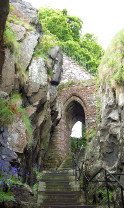
This time I'm high above the Clyde. I'm juggling high-level imaginary functions, overlaying maps across the terrain below, and trying to overlay some history, too. This big old rock I'm standing on was the center of its own kingdom once upon a time, a time forgotten by many people, a time that was not negligible in human terms, some seven hundred years. It was a little territory called Strathclyde, among other names, a start-up after the Roman withdrawal, and continuing on until the Scots gathered the momentum to overrun them. By then, this kingdom was among the last holdouts among the old Britons, along with relatives down in Wales. Set the stage after the fall of this rock for Braveheart and Robert the Bruce.
This rock is Dumbarton. It is one of those vestiges of ancient Scottish vulcanism, (some time before Braveheart … or his species,) a plug of cooled lava surviving the volcano itself, which was scraped away by the glaciers of the pre-Braveheart Ice Age. It's a somewhat ludicrous bit of rock rising suddenly from the silt of the river and from the flat lands close the river, a double humped beast with steep, unassailable sides, perfect for a castle. North of the river are some serious Scottish highlands sneering at the little rock from the vantage of a few miles. But the rock stands proud.
For centuries, it stood with its feet in the river, connected to the northern shore only by a narrow strand of marshland. In fact it was surrounded for some 320 degrees out of 360 by two rivers, one the Clyde, and the other, the Leven, which politely swings around the rock's western flank to empty into the Clyde and its estuary. Now the marshes have been filled in, and a straight road leads to a parking lot near the castle gates.
The rock-island has one small sloping meadow at water-level, facing out toward the river, where ships with provisions or troops landed in olden days. Now it forms the entrance to the museum that has been formed of the castle. Castle is a hopeful term. There's no real castle remaining, just the governor's house facing the riverside meadow, the fortifying walls along all the heights, a prison from Napoleonic times, and an arsenal on one summit that was bombed by the Germans, when this area north of Glasgow was busy building ships of war.
So, yes, I've made the monumental journey from one side of Scotland to the other. Glasgow and Edinburgh are less than hour apart by train, but they seem to represent the antipodes of Scottish experience, at least to listen to the Scots. I compare it to the cultural divide between Rotterdam and Amsterdam, though Glasgow – the analogue to Rotterdam in this comparison – is the biggest city in Scotland, rather than Number Two. There exists the same impression of one being the sophisticate and the cosmopolitan, while the other is rougher and more working class, more 'real'.
I admit that Glasgow has presented itself as a riddle to me. Where Edinburgh was immediately navigable, immediately likeable, accessible and attractive, Glasgow has seemed dark and lacking center. I don't know which way to walk on my first day. Though there are wide avenues in every direction, adorned with Victorian beauties in red and white stone, though one senses the Clyde just south as an organizing spirit, one never seems to arrive at any one quintessential spot that is Glasgow. In Edinburgh, one gazes up at the castle, one strolls the Royal Mile from castle down the ancient streets of old Edinburgh, one strolls the streets of New Town, where the social and the shopping life of the city are concentrated. In Glasgow, one takes in the notable architecture, spread evenly throughout the center, one discovers one street, another, one discovers an understated riverside district, and one feels uncertain.. Have I seen this city?
My first night is distinctly grim. It's another of Britain's mysterious bank holidays, and the town is so quiet. The rain falls softly; the skies are grey. Looking up, I can enjoy the beautiful architecture. Looking street-level, the place seems seedy. And no matter how many corners I turn, I never find a variation. I settle for an unadorned little pub where I can watch some Championship, or second level British football and eat what is a surprisingly good burger.
I'm on the highest of the two summits of the rock. The weather is perfect, alternating between high clouds and sun. Visibility is far and clear. The mountains of the highlands are etched against the sky, looking much milder than I imagine they are. I'm picturing history, picturing the centuries passing over the hills like northern clouds.
Sunday, May 26, 2013

Travelogue 499 – May 26
The Haul
You know I like the smoky, I tell the bartender. He nods. 'And which was the one you preferred, sir?' That was the Ten Laddies, I say. 'That's the one.' He is a young man. Though he has a baby face, a mop of red hair, round baby-blue eyes, and smooth freckled face, he can't be all that young. He says he's worked at Oscar's for eight years. And I would think it takes a number of years of even the heaviest smoking to get teeth like his. Despite the yellow he has a charming smile, which he flashes readily. And despite the hiphop slacker garb, he has a very polite and personable manner. Oscar's is a personable Scottish bar. Everyone is conversating, as my students in North Minneapolis would have said.
By the way, Oscar's is not the real name of the bar. I owe it to a man I never met to disguise its identity. See, I got a tip from a local that a certain local author likes to hang out at Oscar's, and so I spent an hour or two there on my first evening in Edinburgh. That's when Adam the bartender recommended a few brands of Scottish whisky. I've resolved to taste some of the real product while in Scotland. Among the Islays, Ten Laddies is the best. The smoky aftertaste is marvelous. Good call, Adam.
Tonight, the Ten Laddies is celebration. I have run the race. I have finished it. I have even matched my second best time. It was not easy. It was an achievement of will power more than conditioning, since I've had almost a month off. My body attests to it, surrendering itself to such a variety of aches and pains that I actually groan aloud when I enter Oscar's and see that all stools are occupied.
Oscar's is a tiny place. There is barely room for the grubby bar and a row of stools inside the door. There are a few bland breakaway rooms, but I'm not straying from the bar. The clientele seems to be ageing neighborhood types. The conversating is energetic tonight because of the match on the telly. This afternoon, the Hibs and the Celtics are meeting in the final of the Scottish cup. The Hibs are from Edinburgh, the Celtics from Glasgow. When I walk in, the Hibs are down 0-2.
One of the conversators is talking down the Hibs with wit and with some vehemence. He's keeping the locals laughing, even as he draws their playful scorn and insults.
My celebration is short-lived. I can only stand so long. There are thirty minutes left to the game when I arrive, just enough for the Celtics to score one more goal. There's a general dismissal of the local team among the drinkers, and they return to local topics.
I'll need some food. I'll need a chair. I knew I was in for some pain by the second mile. I could sense that I had the power for the race, but not the depth to do it gracefully. Muscles were tired. The old injury settled inside my foot, though with a dull rather than shooting pain. And the effort was all effort, little flow. That said, once I found the resolve to finish, I locked in and enjoyed. The sky was cloudless. The course led us under Arthur's Seat, and after Mile Four, we were running alongside the Firth, running into the warm sun. The sun was too hot for locals, and I listened to some complaints after the race, but it felt great to me. Until Mile Eight, I even entertained hopes of breaking my record. My pace was solidly ahead of record pace. After Mile Eight, I realized how sorely I needed that last month's training, how sorely I needed the flow and the grace. Rugged effort wasn't going to be enough. I finish.
Being solo on these race trips, I realize how some of the hardest work is post-race, when one must make one's way back to the hotel without a ride, without assistance or company. But in Edinburgh, they want to push the endurance test to its limit. There is a twenty-minute walk from the finishing area to the shuttles back into the city, and a good portion of the walk is uphill. Once back in town, I have another fifteen minute walk to the hotel. By that time, I am moving like the tin man after a month of rain. After a hot shower and some stretching, I'm ready for the evening.
'Next year,' I say as I wave good-bye to Adam. He winks and flashes a smile. 'Next year.' Go Hibs!
Friday, May 24, 2013

Travelogue 498 – May 24
The Hill
It's 7am, and I'm taking crazy risks. I can not be held responsible for my behavior at that hour. Don't tell me that I have no right to call an hour early when the sun has been up for hours already. Yes, that is indeed the case. This is the farthest north I've ever been on this silly planet, while silly Europe quickly closes in on summer solstice. It occurs to me I haven't seen the night in a long time, maybe weeks, retiring early, never rising early enough. I haven't seen the stars; I haven't seen moonlight. Strange.
Maybe it's the lack of quicksilver moonlight that has unsettled my mind. I rise at 7am, and I start putting on running gear. A part of me is anticipating some common sense, but it never comes. I leave the hotel in my running gear. I'm setting one hesitant foot in front of the other. I'm running. I pass down my block of Georgian facades, eventually circling around to the back of the hill, climbing its brick roads, its paths, climbing above the city until madness passes for an instant, and I stop at the hilltop, having suddenly achieved a perspective of the northern side of the city and of the estuary.
This is Calton Hill. It's always been here in the middle of town, in the middle of history, but its evident history traces back a few centuries only, and a quirky history it is here on Calton Hill.
I've traveled to the site of my race, unsure whether I'll run it. The foot is still pierced by a needle of pain, though the fiery heat of it may have diminished. Some days the pain fades to nearly nothing. I have had successful trial runs in recent weeks, and some that aren't so successful. I retreat from running to the cycle for days at a time. The night before my flight, I'm debating whether I board or not.
Some 200-250 years ago, the summit of Calton Hill became the playground of a generation or two of inspired city leaders who embraced the ideals of the Enlightenment and made them their own, imbuing them with qualities distinctly Scottish, pragmatic and utilitarian. Engineering, philosophy, high science, and architecture flourish. So does poetry. As the Scottish Enlightenment stretches in span well past the end of the eighteenth century, it should be said it acquires a rosy Romantic glow. Burns and Scott are set beside Hume and Smith and Watt as local Enlightenment figures, and during the monument fever that overtakes this generation and that sweeps over the summit of Calton Hill, these two Scottish authors inspire some of the grandest of the memorials.
The primary architect of the time is William Henry Playfair, himself the nephew of a prominent Enlightenment personality, the mathematician John Playfair. William Henry is fond of Greek motifs, as befits any artist with Enlightenment credentials. The Calton Hill monument to Burns is inspired by the Athenian monument of Lysicrates, circular temple of nine columns, tripod on top, etc.
My favorite is the incomplete national monument, which was designed to be an exact replica of the Parthenon, meant to commemorate soldiers lost in the Napoleonic wars. It is incomplete because they simply ran out of funding. Since then, it's been derided by some as 'Scotland's Disgrace', though I don't see that it lacks grace. In its unfinished state, grass gathering around its base, the stone colouring and weathering with time, the monument carries forward from its day to ours dignity and philosophy. It's a kind of riddle, perhaps only asking, 'What were they thinking,' but perhaps also, 'Why do we put stone upon stone?'
I've arrived at the top of Calton Hill, and without significant injury. I look out over the Firth of Forth on a sunny morning, and I ask myself, 'Why not?' I think I'll do the race.
Monday, May 13, 2013

Travelogue 497 – May 13
The Hump
Part Four
So our new bicycle has been impounded. I have unwisely challenged authority – parking in a pedestrian zone near the station – and so I've lost the bike.
This is Holland. When the cycle goes missing, I don't even think about theft. That's a novel sensation. It's so much more likely to be gentle authority. Anxiety is further blunted by the certainty that I'll be able to track it down via internet in a day or two. Indeed, within two days my bike pops up on the city website. 'There he is!' the beat-up Union standing in profile against a grey wall for his mug shot.
Even being stranded without a bike is the smallest inconvenience. A few blocks away, I catch the tram home. I probably make it home quicker. And I still have Jan's old creaker parked at home. That will be my transport for a few days.
I find the impound lot on the old internet map. It's walking distance, thankfully, up the local canal to the Spaanse polder, an unattractive little district, raised from the marches in order to serve as ugly repository for warehouses and shipping offices and city impound lots.
I welcome the chance to walk. In a city so transport-friendly, I rarely get opportunities to walk for any distance. I'm looking for chances to rehabilitate the afflicted foot. As certain as I am that the new king of Holland would not hesitate to run the quickly approaching half marathon – on one leg if he had to – my resolve has been severely tested. Every attempt to train has been occasion for more pain and for self-doubt.
I don the running shoes, and I set out. It's only a couple miles, maybe twenty minutes along the canal and then down the innocuous streets of the Spaanse Polder. It's one of those nondescript days, clouds high and temperatures just chilly enough to wear long sleeves. It might rain, but probably won't. Instead the skies indulge in the occasional harmless mist.
The foot is feeling fine. I'm encouraged. Though ... what are these other aches and pains? After months of steady training, the body has become used to it. Dropping the routine so suddenly throws the system off. Now just walking a few miles will trigger all sorts of knots and kinks. Age doesn't respond well to stops and starts, even as it necessitates them.
So again, I am forced to face the thing that can't be faced, a fate worse than having a bicycle impounded, a fate worse than cold rain while you're cycling into town. I would have to say it's worse than spending the day in Spaanse Polder. The thing worse than Spaanse Polder is a decision: must I, on my own initiative, cancel the race I've been anticipating for half a year, a kind of concession to age? I'm not ready.
The impound office is every bit as dreary as might be expected, as the neighborhood would suggest. But the staff greets me with a good cheer that admits none of it. There's no hint of the surliness or defensiveness that one would brace oneself for in America or Ethiopia. This is Holland, where consequence is a neutral and impersonal. Beneficial! Where would society be if we all parked on the pavements? What is democracy but a collection of fallible cyclists who make their mistakes and pay their fines? Life is wonderful. Do you have your claim number? Yes, I do, collected from the website when I found the mug shot of my poor machine. Good! I pay my fine, and I'm cycling home through a new rain in ten minutes.
Pedaling into the wind and the rain, I ask myself, will I make it through this awkward middle phase to my trip? And what will survive to the end of it?
Home again, and drying off. I stretch – an act of futility. I pick up one abandoned running shoe from the floor. Alas, poor Saucony. Etc. This is killing me.
Sunday, May 12, 2013

Travelogue 496 – May 12
The Hump
Part Three
The weather has turned, and emphatically so, as though in northern European renunciation of the soul-abasing luxury of excessive heat and light. The winds have picked up, and they blow the clouds forward in waves, relentless fleets to storm the beaches. The sun beams through the breaks in the rolling banks of grey conquest, teasing the soul so recently celebrating the graciousness of spring.
Cycling across town and over the Swan Bridge is a test of the will. The winds are capricious and strong. One might find oneself pedaling only to stay upright. I have an appointment at Stadion Feyenoord. It seems that the Secretary General of the Ethiopian Athletics Federation is in town. I'm to tour the stadium with his delegation, who are conducting research in preparation for final opening of a new stadium in Bahir Dar.
Kismet follows me with such steady devotion that I wonder if it is actually just the order of things. Was there ever such a thing as strange coincidence? Or does this simply describe everyone's life? We marvel over the crossing lines of chance, the events that defy odds and explanation, and maybe we separate them out. These things don't happen, we say. But they do, and maybe they happen with the same bizarre regularity for everyone, but we agree to share in head-shaking wonder.
I spot my crew right away. For me, there is almost no mistaking an Ethiopian. That may sound like a weak claim, identifying Ethiopians in white Holland. But Holland is not so white as it once was. And even among African races, I find the Ethiopian distinctive. Furthermore, I can spot an Ethiopian official with chilling accuracy. There is a look to them. I'm in a mood to be charitable, so I'll refrain from detail.
In this context, the officials are friendly enough, They are on a sweet little tour, Holland and then Vienna. The pretext is research. They have a newborn stadium project in their tender care; they want to nurture it properly. The architects are Slovak, and therefore the trip to Vienna. The trip to the Netherlands is a sort of sampling of facilities in rich and football-mad Holland. I find out quickly that there is no plan at all guiding the Feyenoord stop. Why I should have thought differently escapes me. Their guide is Mulugeta from Amsterdam. He buys tickets for the tour, and away we go.
Feyenoord is Rotterdam's biggest team. It is routinely one of the top clubs in the Eredivisie league, and it enjoys a wholesome, long and bittersweet rivalry with Ajax, Amsterdam's team, the way that the Dutch cities #1 and 2 have for many years. I think that – in the way of most #1s – many Amsterdammers would act very blasé about the rivalry. But not the Rotterdammers, stout city patriots. Their sentiments seems summed up best by an old saying that Rotterdam makes the money while Amsterdam spends it.
The name of the football club comes from a district of Rotterdam, properly spelled Feijenoord, that lies just across the river from the east side of the city centrum. In building the 'new' stadium (circa 1937) the team abandoned its old neighborhood but kept the name. The team still lives on the south side, but due south and about a mile from the river.
If one doesn't (a) get tingly standing next to the pitch of a legendary club, or (b) find some pleasure in a tradition of sports architecture and art, then a Feyenoord tour probably wouldn't be his cup of tea. But I will say there are some nice touches in the stadium: mid-century stained glass depictions of the towns round Rotterdam, funny artsy-cartoonish murals of football in action along the walls of the stadium bar (from 1961, if I understand my Dutch properly,) and odd 30s bits of sculpture here and there, kind of consciously clumsy in a vaguely Cubist way.
I have done my duty. I've met my high official from the national athletics federation. And I've had some fun in football reveries. I cycle back home through the spectacularly deteriorating weather, against prodigious blasts of wind – and I have learned living here that wind is really the defining meteorological phenomenon of Holland – and into the pinpricks of rain, pushing Jan's poor old nag of a bike to its limits, and I reflect that the cosmic WED, the hump, the unanswerable koan of this trip stretches on into mid-May.
Yesterday, one day after picking up a second cycle, in anticipation of Menna's arrival in June, I visit a busy coffeehouse in the vicinity of the central train station. I like this cafe for writing; it is – dare I say it – clean and well-lit. The floor-to-ceiling windows offer some of the best people watching. Travelers from all over Europe stop here between legs of their journey.
The station is a black-hole for bicycles; I should have known better. Train stations in Europe are generally centers of city movement and commerce. The bikes pile up around the station like apocalyptic detritus. There is no way that any Germanic people with self-respect would allow this mess to happen.
There will be boxes, defined by well-preserved white paint, within in one must park one's fiets (bike). The consequences will be … not severe, but certain – carried out with firm kindness, or kind discipline. I leave my bike carelessly, randomly, locked up by a pillar of the business highrise housing my cafe. I can almost see it from my window seat.
When I emerge, my new (used) bicycle – symbol of our future in gentle Europe – is gone.
Subscribe to:
Posts (Atom)