Travelogue 415 – September 29
The Big Day
I'm fortunate enough to be sitting outside the morning after. Ethiopian sunshine – the genuine stuff – lays a stripe of heat across my table. Blue sky among the leaves of the sheltering trees heralds the arrival of baga, the dry season.
Local wisdom holds true to the letter this year. The dry season arrives with Meskel. This holiday celebrates the discovery of the True Cross, (meskel meaning cross). It is one of the two most colorful of Ethiopian Christian holidays, along with January's Temket. What makes the holiday fun is the bonfires on the night before, called Demera.
Demera is a memory chain reaching pretty far for me: four and five year-old boys running around the fire built taller than they are in the school yard. They're singing; teachers are clapping; all quite sanguine about kindergarteners playing with fire. Earlier in the day will have been my birthday party, always following a precise formula: the song while children sit in their chairs, the ceremonial cutting of the cake, photos and kisses. Those were birthdays to remember.
It's late at night, well after most of the bonfires have subsided into ash, when we stumble upon one more, tended by young toughs who would normally be harassing us. Now they are skipping around the fire on the sidewalk like they were boys again, each carrying a brand of twigs intertwined and reciting traditional chants and songs.
This occurs not too long after my birth-minute, and I'm choosing it as the sign of my wonderful new cycle. It's a big birthday, a round number and all. We have come from the calm old Finfine, where we sat in our throne-like seats at the round bar and talked like old comrades. That had to give way to either sleep or to nonsense. That is how we ended up on Wacky Street again.
Wacky Street is a short street with rows of tiny, shabby grottoes devoted entirely to nonsense. Getting out of the cab, we step directly into the scene of the young bullies tending their sentimental fires. We stop to watch and to honor the auguries. Then we enter the den.
You don't go to Wacky Street except for special occasions. You must devote the night to Wacky Street. You wedge yourself in among the dozens of debauching Ethiopes, rammed into one room, who are jumping up randomly to dance to the lunacy of the asmari players. The tireless dancers / singers circle the place, provoking the audience, dancing and cajoling, joking and demanding money. The waitresses are rotund wizards, appearing with drinks you only wished for and tabulating false bills with savant-like acumen.
Somehow the hours pass in laughter and idiocy. The place is a Lynch-like dream that turns like a carousel and never abates, and then arbitrarily spits you out in the early morning into the arms of an unscrupulous taxi driver.
So the big day is done. I'm staring up into a glittering sky. I have spotted Orion for the first time this season, shining alongside the Seven Sisters and the Bull. I'm captivated.
The day started innocently enough, dull errands becoming intent computer time becoming afternoon showers. When the latter had spent themselves, I was escorted to my work party, a harking back to history. Some grads from that first school were there, twelve years-old now. Team athletes were there, as were the teens, as was the team coach. Co-workers managed the event: the birthday song, the ceremonial cutting of the cake, the photos and the kisses. But this time, we had music, and we danced in the courtyard, the twelve year-olds being silly, the teens giggling, the coach stomping in country style. We carried on until sunset, sun setting on rainy season.
The big day comes, the big day goes, as they always do – blithely, sailing by under the power of Kundera's lightness of being. The vessel is manned by acrobats and dancers and gnome-like waitresses. Downstream the lazy river widens into dissolution. What do you call it?
Wednesday, September 21, 2011
Travelogue 414 – September 21
Home on the Range
I'm back to ten thousand feet above sea level. Things look different. The sky is crystal blue this morning. The fields on top of Entoto are replete with high, dewy grass in vivid green, dotted with tiny purple flowers. Abeba is the word for flower; and as often as I am forced to pronounce this word, it does not come easy. I practice with Tesfahun, my trainer. A schwa surrounded by strong Latin A's. It does not roll off the Western tongue.
The abebas are out. It's a new year. It's 2004 in Ethiopia. The symbol of the new year is the adey flower, a yellow daisy that blooms at the end of the rainy season. It's tempting to call it spring, though we are still in the northern hemisphere, descending into shorter days and autumn, just like chilly Bath, England; just like Minneapolis, Minnesota, soon to be an icebox.
Here, New Year's is a joyous time, as much to celebrate the change in weather and release from 'winter' as to celebrate Time's conquest of our hearts.
But rainy season isn't vanquished overnight. We still get the occasional showers. The clouds haven't freed us entirely. This morning it might seem, looking up at the brilliant skies, that one will never see a cloud again. But once one starts running, once one's eyes settle on the mud underfoot, one realizes that baga, the long, dry season, hasn't quite taken command yet.
Fikre leads the running today, in honor of her tenth-place finish in the recent seven-kilometer race. Our team's women claimed fourth, tenth, and fourteenth, a very good sign for the coming cross country season. She leads with an easy lope: I've asked for a kind pace, something gentle for the old man returning to Ethiopia's highlands from damp, sea-bound England.
I can be spared the pace, but not the dangers of the chaka. The slopes are compacted, slick mud. I'm running with hands out for balance. I'm grabbing the trunks of saplings in passing to steady myself. We run along patches of thick moss where we can, like running on cushions. When we break out of the trees, the scene is striking – the green of the grasses, the clean air, the crisp lines of the mountains.
Yesterday was the high slopes and the chaka. Today it's the daget, the hill up from Kusquam to Entoto, twenty-five minutes of intensely steep incline on a dirt-and-rock road. Twenty-five minutes today, which is surprising, given the way I feel, something like the old man I see sometimes here whose rapid, shaking, stooped steps forward have to be measured in centimeters. His tottering advance is about a block every half hour.
It's a grueling run. Tesfahun leads today, and his step is light and playful. He has to pull back sometimes, just so he doesn't drift ahead too far. I'm gasping like an fish out of water and straining for every shuffling step. And yet, somehow, I manage my second best time up the hill. I can't say whether that's a sign of residual glory from past training or a measure of exactly how pathetic my condition has always been.
Either way I'm happy. We emerge at the top of the hill among the sordid commerce by Maryam church. And we jog toward the brilliant fields, refreshed and awakening to the sunlight of a new year.
Sunday, September 11, 2011

Travelogue 413 – September 11
Is it a Country?
Today's the day of history, the only one we're allowed this century, it would seem. Even in the United Kingdom, we commemorate all week, secretly sighing over our poverty of occasions of moment. Analysis is little more than repeated phrasings of 'decline of the west'.
My mind is occupied with smaller quandaries. 'Is this a country,' I wonder. A lot hangs on this question. Just about every year among the last ten, I've managed to make it to one new country. This year's quota hinges on the identity of this little corner of the world. Only in Europe could one be faced with this riddle.
Here's the evidence: They have their own flag. They have their own language, printed prominently on bilingual signage. I strain my ears for a hint of it being spoken, but have no luck. They have their own team in the playoffs for the Euro Cup. They have their own team in the Rugby World Cup. They have a national assembly. They spend their own money, by and large. Crossing the border, one notices a difference in manicure of the landscape (for the worse, I might say).
My last two days in the United Kingdom are spent in another country. Only an hour from Bath, across the River Severn, lies a land, discrete and autonomous, a strange and mountainous land named Wales, or Cymru in their own, odd language, made up of improbably groupings of consonants.
The genesis of this trip lies in my profoundly mediocre showing in the half marathon last month. I do a quick search for 10Ks in the region and find one in Cardiff on my last day in the UK. I sign up. Coincidentally, Mark has just taken a job in Cardiff. I figure it's an opportunity to visit him, tally up another country, and test myself as a runner one last time this year. I can't allow all those months of training to have only one lackluster time to speak for them.
The train emerges from the Severn Tunnel. Immediately, yards and fields are unkempt and shabby. What towns I see are fairly grim. Cardiff is no exception. It seems to me gritty and hard as Nick Nolte at an AA meeting. There are bits of the center that are nice enough, but pointedly so, as though putting on a brave face. The River Taff winds through downtown, by the castle and the pleasant downtown park made of its grounds, by the Millennium Stadium, by the old Brains Brewery, by a few nondescript housing blocks, and out to Cardiff Bay, where a few other blank millennial builds try to offset the industry of the port. The High Street could be Main Street in South Dakota, with its squat, nineteenth-century, stone commercial buildings, elegant in their way, but erected with sober purpose. But it could never be South Dakota because High Street is laid with brick and no cars are allowed.
At one end of the High Street is the old castle, the town's first reason to exist. This is the site of a Roman fort in late imperial days. William the Conqueror first began the work that would make a castle from a Roman ruin. And successive lords have done their part, in particular a fanciful Victorian master, to make the castle a tourist sight, a classic of Gothic revival. Kind of fun is the Animal Wall, nineteenth century sculptures of fifteen animals climbing over the walls of the castle grounds.
Old Caerdydd ends up being a charming stop, the grimness probably a product of my own dread of the work that faces me at the other end of my journey, in Ethiopia. Travel is always colored by the destination. I am ready to be indulgent. The Romans believed in it. So did Owen Glendower, who makes an appearance in Shakespeare's Henry IV. And let's not forget that Old Caerdydd has only been capital since 1955 of this … country. It takes a while to grow into one's glory.
Tuesday, September 06, 2011

Travelogue 412 – September 6
Hey Ho
'With a hey ho, the wind and the rain,' I'm singing as I walk down the hill. It's the second day of rain here in Bath, and this morning it is dark and steady. The winds are a-trilling as well, bending branches and setting up a considerable noise among the woods on Beechen Cliff.
This song has always made me fond of Twelfth Night. It's such an odd way, so whimsical and dark, to end a comedy. Perfect, really, as there are ways in which tragedy cannot match the darkness of comedy in theatre or in poetry. The tragedian must use the language of a believer.
'When that I was and a little tiny boy,' I can sing, and testing out a variety of Pseudo-British accents. The only thing I cannot do is settle on a melody. I know there are versions of the 'song' put to music out there, but we can never know what tune was wafting through dear Will's bright mind, can we? I'm trying to fit it to 'Don't Worry, Be Happy'.
'For the rain it raineth every day.' There is sweet religion there. As I wend my way down my hill, just one of those that ring the town, young boys are laboring their glum way up. They have started school again this week. It's autumn, and the lord headmaster will have us know it.
'But when I came to man’s estate,' I come to commerce; I arrive in town. It's time to leave the elements to their song. Inside, I set up the infernal machine of work, the winking screen that shapes my hours. These windows allow no rain, allow no sun. They browse and process, and they calculate. But there's no third dimension to a pixel.
'A great while ago the world begun, with hey, ho, the wind and the rain.' My Somerset story has run its course. I arrived in summer and will leave under the shadow of fall. Today will be my last day's work. There are meetings in London. There is my last race of the year in Wales. There is a plane to board toward Ethiopia. It's been a wonderful interlude, a scent of lavender by the Avon.
'But that’s all one, our play is done.' At night, I'll shake the rain off me cap, won't I? and set it tenderly aside. With any luck it will be dry for tomorrow.
Tuesday, August 30, 2011

Travelogue 411 – August 30
The Summation
The only thing on one small table in my room is the paper written over in Amharic, a simple document, with a letterhead and one paragraph of text, and the all-important agency stamp. One piece of paper, it's a heavy sheet, a burden. Sometimes I stare at it, measuring it with my eyes.
As much as any paper could, this one captures a human life within its weave and its ink. This is the certificate of a race time issued by the Athletics Federation, passed to me by Mekonnen, athlete and former member of our team. It's his best time yet, summation of a young life's achievement.
He ran so well for Team Tesfa that several years ago he was courted by organizers of what was then the new 'Tirunesh' camp, a government-run facility for young athletes with Olympic chances. Several of our runners left for the camp. Only Mekonnen has stayed the course there. The camp is far from Addis, in the countryside. They provide food and some education … and day after day of intense training.
For years now, running has formed the entire substance of his life. He wants nothing else. The day before I left Ethiopia, he came to the office with this piece of paper and his diffident smile. As important as the paper is, it has already become crumpled in the transport. Ethiopians can be a bit clumsy with paperwork that way. It's as though the thin shreds of chatter aren't completely real for them yet; good for them.
Mekonnen is not allowed to compete in Ethiopia, unless it's a camp event. But we can represent him to run internationally. He pursues me out of the office as I leave to pack, and he asks me for my phone number. I smile; 'I'll be in England, Mekonnen.' He continues to smile, though he's not sure what to do with that information. He's a very sweet guy. He came to us straight away once he was let go for summer break, telling us he still misses everybody, and offering a hand if we need him. He has his motives, of course, but they are so mild, and so submerged in genuine sentiment, that I can't help wanting to help.
If my life could be summed up in a page, it might just now be a spreadsheet. I play with numbers. I calculate; I review; I project. I've begun seeing the spreadsheet as a form of poem, heightened language, condensed meaning. So much of significance gets stripped down, captured in digits, poured into the columns and rows of the spreadsheet. One document becomes a powerful statement about a group of people. It's philosophy. It's an aesthetic work of symmetry.
The balloons are up this morning, drifting up above the fringes of western Bath and above the fields and the vales between here and Bristol, seeming halfway to the ceiling of rippled clouds. I'm surprised to see them today, on the business day after the last bank holiday of the summer.
They rise regularly from some hill or other and lazily drift over town. One sees the occasional glow of the fire inside the base of the balloon. The balloons are silent, nearly still. I can watch them and feel something like meditation. I am lifted from the spreadsheets. And what do I see? The fields and the vales, and the days left to me in England. They aren't many.
Monday, August 22, 2011

Travelogue 410 – August 22
The Schools
Part Two
Stunning are the edifices we inherit from the inspired Cambridge intellectuals, high halls and Gothic chapels and elaborate gateways that are every bit as somber and earnest, playful and smirking as college students, set among their sweetly restrained gardens and the subdued skies of Britain.
While you're in Cambridge, be sure to spend some minutes on the King's Parade, dramatic piazza before the gates of King's College. There you have your first breathtaking view of King's College Chapel, high Gothic at its most striking, built by Henrys VI-VIII, boasting the largest fan vault ceiling in the world. This grand church has survived housing Cromwell's troops, who busted all the original stained glass. It will survive our irreligious gawking. Be sure to spend some minutes sighing over the Bridge of Sighs in St. John's College, a Gothic (though 19th century) covered bridge over the peaceful River Cam, looking as romantic as the name, particularly standing close over the boats being punted underneath in summer.
As it happens, Oxford gets a second chance with me only a week later. I have a meeting there. I'm happy to make the meeting, not so happy to re-visit dreaded Oxford. But Life often forces me to reconsider. That's the kind of relationship Life and I have.
As I say, Oxford has provided me my education: I bow my head disembarking from the train, refusing Oxford its malign 1209 shadow over my naïve trust. This time it's summer. The day opens as it advances, the morning's chill dispersing into astonishingly blue skies. My meeting wraps up in late afternoon, and I am released into the accursed city at a blessed moment.
I decide to allow Oxford an hour to win me. And this time I find a side to the town I hadn't the fortune to see the first time. Granted, I didn't try too hard, caving to disillusionment rather quickly. This time, I see the wonderful Bodleian Library, set against Radcliffe Square, the Radcliffe Camera and the University Church of St Mary the Virgin, the university's official church, and a beautiful one at that, The Radcliffe Camera is an eighteenth-century round, domed building, originally a separate science library, but finally consumed by the Bodleian.
Next door is the Sheldonian Theatre, built in the seventeenth century according to a design by Christopher Wren, built expressly to take the secular ritual of graduations ceremonies out of the university church. Over the years, it has served as a lecture and music hall – Handle made his appearances there – but never as a dramatic theatre – even though it's design was in part inspired by the ancient Roman Theatre of Marcellus. What makes the place fun are the goofy stone heads that adorn the railing around the theatre, grimaces and smiles borrowing from the dramatic tradition, regardless of the use put to the building.
Keep walking south, and you encounter the Christ Church Meadow, wide fields devoted to grazing, to sport, and to summer picnics. These fields extend as far as the Thames, where the punters and rowers are again active in numbers. Oxford is nothing without its arcane traditions: this part of the Thames is traditionally known as the Isis. It seems as though everything must have several names here and, of course, a collection of associated apocryphal tales. Sadly, all the medieval code seems finally to be fading, unable to compete with bland modernism, the sarcasm of post-modernism, and the apathy of international students. Such is life.
I end my tour at the 'Head of the River' pub, which stands by the Folly Bridge across the Thames. It has a terrace beside the river, a perfect spot to watch the boat traffic and the antics of some of the student expeditions on the river. I sit in the sun, I reconsider my previous judgement of Oxford. Harsh, really, don't you think? I take a taste of bitter, and I contemplate. Yes, quite. Maybe we all deserve a second chance. Cheers.
Sunday, August 21, 2011

Travelogue 409 – August 21
The Schools
Part One
Influenced as much by the vagaries of British transport – there seems no easy way to get to Lincoln in Lincolnshire – I've determined that my tourist stop after Grimsthorpe will be Cambridge, a quick train trip south from Peterborough.
I visited Oxford last spring, and that was a thoroughly disappointing experience, particularly for a frustrated academic who has romanticized the grand old European universities for a lifetime. The town seemed trashy and noisy. The colleges seemed locked behind walls, which themselves were obscured by the mobs of flippant French high-schoolers and Japanese chain-gang tourists.
I've learned my lesson. Exiting the train station in Cambridge, I duck my eyes well below the bill of my cap and withhold all judgement, like holding my breath, until I've passed through the city districts adjoining the station. I should know better, university towns in the U.S. are the same, attracting all sorts of experimental and tentative personalities, all those who are stalled out in life, stalled in fortune or dallying in adolescence. There is a ring of blessed compassion around universities, similar to what may have surrounded the medieval churches that they sprung from, an atmosphere that attracts afflicted souls.
The mile-long gauntlet run, beautiful Cambridge opens up to me. I might have felt like the first refugees from Oxford who came to Cambridge in 1209, fleeing persecution in the ugly first university town, and setting up shop along the banks of the kind River Cam, or River Granta, as it was apparently called in earlier days.
Trusty old Roger of Wendover, high medieval gossip, tells us that an Oxford student killed a woman in that fateful year of 1209, and townspeople rose in a mob against the school population, hanging several students. The good King John seemed to applaud this turn of events, being excommunicated at the moment because of a dispute with the Pope over a clerical appointment. Anything smacking of church was receiving no protection from the king. The university closed down for a while, and scholars went in search of greener pastures.
There are plenty of green pastures in Cambridge, even to this day. While in Cambridge, make a point of strolling among the lawns of 'the Backs', which are across the River Cam from the colleges. They provide peace and privileged views of the beautiful medieval college complexes.
The first of the surviving colleges to be founded was Peterhouse, founded in 1280. It's now one of the smallest of the colleges, and the southernmost among the chain of schools along the river. You can take in all the colleges in a short walk from Peterhouse up to Magdalen College, (founded in 1458), near the curve in the river that constitutes the approximate site of the original, ancient settlement that became Cambridge.
So why the breakdown between 'colleges' and 'universities', and what was it that our 1209 refugees fled to, if the first college was founded 71 years later? It seems, if I'm understanding the history of European universities correctly, that higher education was the province of church men, but in a kind of free enterprise method, in which schools were set up as independent enterprises with church sanction in order to train bright candidates for clerical service.
As Roger's harrowing tale demonstrates, life as a pious college scholar was no guarantee of protection from the rough and tumble of life in medieval England. So it is that the scholars, shameless liberals even then, organized collectively in associations called universities.
So when Roger's exiles fled to Cambridge, it was because there were already schools in place there, as there were in a few other owns around southern England. It was apparently the entrance of this wave of new blood that gave Cambridge the impetus to grow into the number two spot.
Monday, August 15, 2011

Travelogue 408 – August 15
There's Best and Best
I've turned in my athletic performance for the summer. It was the best I could do, and I use that phrase fairly literally. There are best and there are bests. In this case, I was working at my limit throughout the race. I have the aches and pains on display on the day after to more than prove my case. I feel a wreck.
I'm not so much of a wreck that, when I awake and see the sun shining, I hesitate to place my grieving arse on that instrument of terror, Sheila's bicycle, and with a great groan launch toward Bourne for my last morning of touring in Lincolnshire.
Thinking about the race as I cycle – my knees wouldn't let me forget – I'm thinking that I accomplished what I meant to. I ran that race with everything I had. That the result was less than dazzling is immaterial. I did my best. And in doing my best, I was blessed by near-perfect conditions. I have to be grateful – so seldom does Nature bother supporting us in our small endeavors, and so seldom are we grateful when it does. I had the weather with me; I had health; and I had a course that fairly well matched the conditions of my training in Ethiopia. There were hills and more dirt track than asphalt. I can't say much was lacking for a good result.
And that result? On paper, one minute faster than my last race, where I wanted ten, and NOT my personal best. But somewhere among the top twenty-five finishers, I'd say. Ironically, I was defeated by the terrain, the very terrain that I felt would be one of my strengths in this race. One would have to be phenomenally fit to make this course provide a great time. A few grim hills hit you just when you're struggling; there are stretches on uneven grass; there was a persistent headwind that miraculously seemed to find us at every turn. Given a flat course on asphalt, what would my training have yielded? We'll have to wait for the sequel, a race in the Arizona desert I'm looking at for winter.
In the meantime, it's the day after. It's the time for relief and celebration. I'm built for anxiety and 'what's next', but I have a strong ally in authentic relaxation, and that is the sun. My friendly relations with the universe seem to have extended beyond the race. I was astonished to pull back the blinds this morning and see a ravishing blue sky this morning. I gasped – though as much because of the pain rippling up my calves, thighs and through my bruised backside as in response to the sunshine – and couldn't help a big, celebratory grin. I gulped down my muesli as quickly as I could in order to get out into the day. What with rainy season in Ethiopia and Britain being Britain, it feels like a long time since I've seen a pristine blue sky like this one.
Shall I craft a moral to the story? I kind of feel like it, so please bear with me, in solemn respect for my hard-earned aches and pains, or skip this paragraph if you must. The moral: if you love something, go out and do your best, making no excuses. How's that? It 's an easy moral to digest. And yet, it doesn't quite capture it. No, here's the real moral: exercise integrity. Know when Nature has done you a good turn. Acknowledge when you've been handed the chance to do your best unimpeded. THEN apply moral #1. I think it must be one of the supreme pleasures in life to receive a bit of circumstantial joy in an adverse world.
I'm coasting down the country lane. All is still, and as long as I'm still on the seat, my aching muscles don't persecute me. The fields expand peacefully toward the horizon. Behind me somewhere are the castle grounds where the race started and finished yesterday. I somehow feel their calm and restfulness, and it's a comfort. Why do humans invent with dangerous playthings like bests? Behold the lilies of the field, how they grow. They toil not, neither do they ache.
Saturday, August 13, 2011

Travelogue 407 – August 13
Lincolnshire
I'm in Lincolnshire. I've arrived for my race a few days early, to rest up and to get to know the area.
This is an area that gets a bum rap. You receive this impression immediately. The residents make apologies. It's boring, it's flat, they say with a shrug. But they love it. If flat landscape is a communal character flaw, what will they think of Minnesotans? They should fund a citizens' booster field trip to the American Midwest.
In actual fact, the landscape is lovely. And not flat at all. Undulating is the perfect descriptor for it, with low rolling hills stretching for mile after mile. At this time of year, the fields are golden, divided from each other by dark green copses. The skies are low, gathering in amiable humidity as the day passes mid-morning, shredded by vague clouds that bestow only tender occasional drizzles.
The journey here from Bath was long and tedious, six hours train to subway to train to bus. That much only gets you to anonymous little Bourne, where all lines seem to stop. The final leg ends up being a taxi. There are five miles and ten pounds left to reach the village and castle of Grimsthorpe.
I'm staying at the Black Horse Inn, one of a handful of roadside buildings on the busy road northwest from Bourne that comprise the healthy village of Grimsthorpe. If you happen down this stretch of road, I can recommend the inn. It's set just across the road from the castle grounds. It's comfortable. The inn has its own pub that serves great food. Richard and Sheila are the latest to own and operate the inn, latest in a chain stretching back to the eighteenth century, so they say. They are exceedingly welcoming and kind.
Richard and Sheila are puzzled by the sudden influx of runners. There have been a few ultra racers stopping in already. In addition to Sunday's half marathon, there are a 70- and 100-miler on Friday. Apparently, the Grimsthorpe running events are kept very low-key, as none of the locals know much about them.
I have a chance to meet a few of the event organizers yesterday, on that ultra Friday. They are nothing if not low-key, young guys with runner's bodies and diffident British manners. I have a few questions about the Sunday race, and they are met with that disconcerting British deadpan, a kind of embarrassed regret for your rash approach, with averted look and coy and curt half-answer. 'Will there be mile markers on Sunday?' I ask, amiably. There follows the long pause in which the interloper must reflect on his boldness. 'There might be,' comes the answer, delivered with a mordant smile and a tone that matches shyness with defiance. I think I'm supposed to be abashed, but I don't abash too easily. Rather, I'm left wondering what it is about mile markers that strikes this poor sod as so terribly private.
Once I'm out at the Black Horse, I realize that I'm somewhat stranded. Going anywhere will be ten pounds a pop. Richard and Sheila come to the rescue, dragging out Sheila's old mountain bike. I'm ecstatic. I haven't been on a bike all year. Of course, this one requires a painful bend of the leg to operate. And the seat seems designed to torture. After a mile, my backside is in agonies. But it's a bike.
The first thing I do is take a tour of the race course. I manage to squeeze a map of the ultra course from the Spartans in the HQ tent, and I head out on my little torture machine. It's a beautiful day, and it's a beautiful course, by turns winding through woods on a dirt track and then jogging alongside fields of ripe wheat. The half will be a challenge: there is precious little asphalt and precious few flat stretches. It's not a course for time. But it's a pretty one.
The next day, I get to explore. I take the bike out on the country roads. My goal is to make it to the town of Bourne, my nearest source of espresso and wireless. Richard draws out a course by which I can avoid the main road. British roads are frightening: too narrow, curving wildly, and populated by confident locals in speeding, swerving little cars careening inches from the margin.
My course is peaceful and scenic. I am as happy as I've been in months, pedaling along the country lanes, first through Elsthorpe, then over the ridge toward Hanthorpe, and then down a lovely dirt track to Cawthorpe, with always a view of miles of farmland. At the other end of Cawthorpe, I catch the highway that aims north toward Lincoln, but heading south into Bourne. I park my bike across from the Costa Coffee and discreetly massage my bottom for a while before I can walk normally.
Wednesday, August 10, 2011

Travelogue 406 – August 10
Bolingbroke
The evening toys with us, giving us neither contentment nor grief. It's another equivocal sky over Bath, England, the clouds absorbing light and heat but leaving the ground dry. I don't mind. There's a kind of beauty to be found in neither here nor there.
If the skies of England take no sides, the people certainly seem to. There is turmoil in the streets. It has provided a steady warlike drumbeat to the background of my English travel, starting up pretty much on the evening I arrived.
There's a lot of strangely effete soul-searching in the papers about it. Who's doing this? What does this say about our times, about our Britain? These are great and somber questions somehow made frivolous by the unmistakable whine in the tone of the press. Or perhaps it's a kind of dead ritual. 'How could this happen? How do we interpret this?' They might have cut and paste from articles about the recent economic set-backs, perhaps from the Sport page.
The attempts at philosophy are somewhat undermined by the news photos occasioned by the troubles, I must say. Some convey the necessary gravitas, cops in riot gear, cars on fire, etc. But most are rather banal portraits of trashy teens carting off consumer goods. Many haven't bothered with camouflage, and look like they happened upon the action after a day in the park.
With this as my dramatic backdrop, I can report a milestone: the first time I've seen Shakespeare performed in England. In all these years, I haven't had the opportunity, oddly enough. But strolling by the Theatre Royal on my very first day in Bath, I couldn't help but catch the promotion for my favorite of Shakespeare's plays, Henry IV, Part One. I could not believe my eyes. Timidly, I ventured into the box office to inquire and discovered that I had exactly one performance available to me before the show packed up and moved on to other stages.
The performance was an afternoon show. (Part Two plays this evening.) Afterward, I walked out of the theatre into Bath's compromised sunshine, feeling completely exhilarated. The sunlight appeared to me as crystalline as Ethiopia's in October. The town seemed blessed. Citizens and even tourists spoke in verse.
Henry IV is, of course, one of Wm's history plays, depicting fragments of the troubled reign of Bolingbroke, a character last seen in 'Richard II' as the conniving usurper, plotting against one of Shakespeare's most sensitive and poetic of characters. A PR challenge from the start. Truthfully, old Bolingbroke just never achieves that sine qua non of modern American politics, 'likability', though his grim carcass is paraded through three distinct history plays, and though Wm seems to try his level best to at least dress him up as respectable, (part of the job description of a playwright popular at court – any crowned monarch must be legit). But Wm opts rather for the theatrical tactic of making the heir apparent – future conqueror and hero – the beguiling one. Blood still counts.
And dear old Falstaff. This is where Sir Jack is born, inside this play, to become one of the great creations in literary history. The actor, a certain Desmond Barrit, was up to the challenge and the joy. But I'm afraid the director succumbs to the temptation of all directors of Shakespeare, the temptation of putting his stamp on the play, the play a thing that somehow manifests longer life and more vitality than the sum of any director or troupe that assays it.
Poor Wm, who really was one of the first to approach characters with a psychologist's eye. His work will always be accepted as an invitation to analysis by lesser mortals. The best practitioners of theatre will simply stand out of the way. Do not impose. That Prince Hal is divided about his friendship with Falstaff becomes obvious. That is how brilliant writing works. No need for awkward blocking.
Fortunately, with a company of this caliber errors in judgment stand alone among long streams of pleasure. Okay, I see no need for Hotspur to fairly jump around in tempers. We get it. And I would paint Prince Harry as more calculating and less colic in his interview with Daddy. But I suppose this is just the temper of our times, when anyone who would be politically relevant in Britain must smash a window or two on High Street and hoist new trainers for the news photographer with a cocky scowl lifted from one rap star or other.
The theatre itself is a delight, well worth a stop in while you're in Bath. It became the first royal theatre outside London in 1768. And though both waves of construction exhibited within the current edifice are nineteenth century, it retains its eighteenth century feel.
The skies continue to withhold comment. And the spirit of Richard II rhapsodizes on death and honor, as does poor old Falstaff. I'll head home now, before unequivocal night falls, spreading its share of either silence or mayhem across England.
Thursday, August 04, 2011
Travelogue 405 – August 4
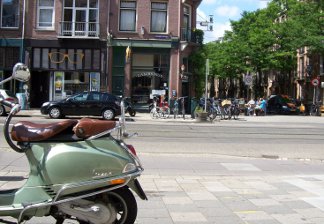
De Pijp
I'm feeling like I'm in heaven today. The sun has shone steadily since five or so. The temperature is nearly perfect. There's a slight breeze to move the dense, sea-level air, air that is redolent, humid and full of the suggestions of sea and flowers and clean, modern cities.
The experience of travel has already receded in my wonderfully resilient corpore so nearly sano, though it must be said that I barely 'experienced' the flight out of Addis at all. The travel was a species of void, a taste of non-existence, particularly after the acute pain of the passport and security lines. I spent nearly two hours in that mess before the long stroll down the suspended tunnel that feeds one into the throat of the flying beast.
KLM offers an overnight to Amsterdam and a day-flight back to Addis. For the overnight, I decided to splurge on a minor upgrade, a seat they shamelessly market as comfort, abandoning any pretense that comfort is a right with any ticket. Settling into my few extra centimeters, I dig out my supply of melatonin and down a few in a desperate attempt at speedy unconsciousness. Even so, I make it through two movies – vaguely imprinting Brody and Gyllenhaal in my diminished mind. I remember something of Greece, islands outlined in the night in the feeble lights of civilization. I recall meals sealed in impossible little boxes and plastic containers. But sustained awareness is only awakened again at Schiphol, in the halls of which I wandering wake, bag recovered, and so is daylight.
The daylight isn't much to inspire adventure. In fact, it is hard to register any change at all in location judging by the weather. The temperature is the same as Addis; rain is streaming steadily down on Gomorrah. I remain at Schiphol for hours, settling in at a cafe, studying nothing at all but the shadow play of modern life in the forms of rushing people pale and intent.
Today is a new matter. I have drunk deeply of sleep and of daylight. I went to bed before the sun had finally set, and I was up this morning well after old boy had come back around. And this time, he battles with very little atmospheric condensation. He shines benevolently on my shoulders as I stroll toward my new neighborhood.
You see, this time I've had to reserve a room in a different hotel. The internet usually offers up my old standard, the HEM Hotel, among the top choices. But summer tourism throws a wrench into all good works, and I found myself in an entirely new price range. Hence the hideous green highrise, the Novotel. Fortunately, the hotel's forbidding outside belies a different standard inside, and I am shamelessly enjoying the luxury that summer and the internet forced on me.
And I get to explore a new neighborhood. The immediate environs of the Novotel are unpromising. Except for the pretty and expansive park across the busy street, it's like being dropped into the worst combination of corporate park and convention center wasteland. But if one is intrepid, and one walks north, toward the center, one finds happier pastures. In point of fact, one enters de Pijp. Pijp is the name of a district of the city, just outside the rings of canals that define the historic centrum. (What is it about this town that lends itself to adolescent, slightly sad, puns on its reputation? A district named Pipe, the school named after Saint John the Doper...)
As far as I can tell, De Pijp is the most nearly authentic Bohemia in a city full of counterfeits. But does the fabled Bohemia still exist in our comfy Western cities? I'd call it a dubious proposition. Some of the accepted symptoms are in evidence: independent book sellers and neighborhood cafes; immigrants African and Middle Eastern; art galleries and disheveled young wannabes. And yet there is an underlying prosperity in the Netherlands that is hard to escape, and the accompanying sense of well-being that turns any counterculture into a pose.
So I stroll through the Edenic Bohemia in my sleepy mood. I find a book that I can stand, and I buy it. I find a cafe owned by extraordinarily loud West Africans. I drink very good coffee, and I contemplate the sunshine on sidewalks. The mild humidity envelops me and gives me comfort.
Sunday, July 31, 2011
Travelogue 404 – July 31
Dank and Anonymous
Things are improving quickly in Addis, but it's still true that indoor spaces in Ethiopia are not cheerful environments. Lights are dim, and there is no heat. The ratio of window to decrepit plaster is discouragingly low. And personal space comes much more dearly than in the West.
All this makes rainy season even more miserable than it needs to be. One escapes only the precipitation by going indoors. The rest – cold, damp, and lack of light – remains with you, like gaunt beggar children at your elbow.
Last night, as Arsenal gave up a two-point lead to the Boca Juniors in dispiriting fashion, we struggled to make the most of the dark and cold bar. The place was crowded, as anywhere will be that broadcasts either Arsenal or Manchester United games, so chairs are lined up right beside our table.
Trendy bars in Addis tend to mimic rather banal elements of US bars or restaurants, and package them as chic. This bar has adopted the sports bar motif, with half a dozen TV screens vying for patrons' attention. The result tonight is that the avid Arsenal fans beside us are staring past our profiles toward the big screen across the room, while we watch the game on a smaller screen hanging from the square pillar in front of us. In a country in which dead-pan staring is an ancient art form, it creates an unnerving effect.
By the end of the first half, my eyes are hurting from the close blast of intense light from the TV in the dark room. I'll have vivid football ghosts on my eyelids all night. So what do I do? I turn on the netbook and check email. And I fry my eyes with internet for a while.
The neighborhood is Tele Medhane Alem, one of the new, instant entertainment districts in Addis. When I first came to Addis, this area was open plots and dirt roads, with the massive new church at its center still being constructed. The church became the kernel around which the neighborhood grew. It wasn't until the new asphalt roads went in, connecting it with Bole and with the center of town, that the boom started. Now the place is teeming with hotels, restaurants, and night spots. And still going. Walking these streets you feel like you need a hard hat: most of the structures around you are unfinished, layers of concrete slabs rising into the sky.
Another of our spots here is Guramyle. I like this place, it feels like the most humble and yet coolest of Addis grottoes. On Monday nights, they host a jazz band that I like, a quartet with a small rotation of pretty good musicians. Sometimes it is fronted by two Scandinavian guys on sax and guitar. They are wonderfully self-conscious and proficient. On other occasions, the band is fronted by Ethiopians, two guys freer and equally proficient. The Ethiopian guitarist is impressive. His music is clearly the wilder side of him. Clean cut and dressed like a good college boy, he slouches on his stool and blandly checks out the women in the audience. It's rainy season, so the band is all Ethiopian now.
We stand at one of the high tables in back and watch the band. The crowd is a rare mix of Ethiopian and foreigner. I look around the place. I love the atmosphere, and yet have to admit it's a kind of anti-atmosphere. There is little to define the place. Windows here have been reduced in size and function to expressionist décor, black boxes that say most by saying nothing. The walls are each painted a different shade, somehow both both grim and bright. There's one huge poster over the stage, a photo of the Scandinavian version of the band, Olaf captured in a pose that self-consciously portrays abandon. I reflect that it's often in the most anonymous places that one feels one's location most. Here, I'm really in Addis Ababa for a moment. Keenly I feel faraway from home, in a strange land, a sensation I rarely feel in one of those traditional venues that try so hard.
In a few days, I'm off to Europe. Stay tuned.
Sunday, July 17, 2011
Travelogue 403 – July 17
Harry Potter in Ethiopia
The movie makes it to Ethiopia, and I make sure that we're there to see it. I've been following young Potter since about the third of the series. Despite growing reservations, I have been a steady consumer.
Opening night at the Edna Mall theaters is usually a sell-out, but there are plenty of seats available for Potter. It makes me curious about what the Ethiopian experience of Potter might be. I noticed that the afternoon show was a sell-out, but not the evening show. In Africa, perhaps Harry Potter is still children's fare.
To give an idea what sells here among English language films, 'Fast Five' lingered for a month, drawing crowds the whole time. America's comic book hero movies usually come and go pretty quickly. This peculiar brand of American infantilism doesn't export with the same power as muscle cars and guns.
I can't measure the Ethiopian response to Potter, especially the latest version of him, so prim, so grim, so stalwart. The theater is silent. A third of the crowd gets up to go as soon as Voldemort has been vanquished. This is standard Ethiopian practice – they don't seem to have the patience for our sappy wrap-ups. Good for them.
And my own response to the boy wizard's story, become so grandiose. I don't know. Wasn't it all more fun when the world wasn't at stake? Heroes and villains sell; but must Potter be made to serve as Savior?
It occurs to me that I'm not familiar with any epic traditions in Ethiopian culture, though I'm admittedly no expert. There are plenty of historical heroes, but no tragic and larger-than-life heroes, mythical giants, or demi-gods that I'm aware of, unless one counts the rather baroque medieval saint's tales. Did Joseph Campbell dig among Ethiopian archetypes? I don't recall. Doesn't it seem as though the great hero mythologies are northern in origin? Weren't even the great Greek heroes imports from the northern Doric traditions? Ethiopian audiences aren't plugging into the same psychological legacy as they watch Harry Potter become something operatic over time.
Particularly galling for me was the ghost scene, in which all Potter's dead family and comrades emerge from the trees. This is after Harry has found out he is destined to die. The ghosts are all very solicitous and caring. They say all the right things, like death doesn't hurt and that they will always be with him. It felt like Rowling was suddenly roused from her blood lust and thought she might do well to comfort some of the dazed little kiddies.
It doesn't help that I have recently survived another anniversary of Leeza's death, and dismally so. The day was grim and dispiriting, sunk in a sense of futility. No ghosts came shimmering to my aid. But then I am no wizard. And no noseless conquering demon has taken an erotic interest in me. I languish in the shadows of the mundane, in which Muggles muddle without solace, earning a day's bread and quietly missing their dearly departed ones.
Friday, July 08, 2011
Travelogue 402 – July 8
Rainy Day
Rainy season is called kerempt here. It has become entrenched in Addis Ababa. It has entered into us, permeated our pores, mixed with our blood. We tremble when we look at the sky. We walk differently; the surfaces of our world have become treacherous. Everywhere is mud. The concrete courtyard is slimy with condensation and moss.
The fields in the mountains are already turning an Irish green. I'm traveling up into the mountains every day or every other day. I am ambitious – and it takes kerempt to vividly illustrate the perversity in ambition. I am ambitious about my August race in England, and somehow my ambition survives every ugly challenge thrown down by the weather.
Twice now, we've driven up the mountain, and the sun has been shining. All auguries pointed toward a sweet run in the woods. I'm at the peak of my race training, so I have to keep going for well over an hour, sometimes for two hours. Some time near the first-hour mark, invariably the thunder begins. We carry on, but shrinking into ourselves, bracing. The rain begins, and we condole each other, 'Ayzu!' Within five more minutes, the rain is coming hard and cold. I've dressed in a cotton T, which is quickly soaked. Not long after, the denuded earth has had its fill, and water is running everywhere, collecting among the few grasses, rushing down gullies and pathways, We are splashing along, and slipping in the mud. And then the hail starts.
Today, the portent of bad times was a disoriented hyena. As close as it was – no more than fifty meters – Fikre and I might have missed it if Altaye hadn't pointed it out in his usual subtle way, stopping and shouting and pointing out the deadly creature. To be fair, this one didn't put on too deadly a demeanor. It was small, probably young, and it gazed dimly around in a fashion that suggested blindness. They say that hyenas don't see too well in the daylight. Fikre saw no need to evaluate alert levels. She immediately picked up a stone and threw it. We heard it crack against a tree trunk. The hyena was unfazed. Neither was it inspired to aggression It stood its unsteady ground, searching the gloomy forest with the air of a lost pup.
We reached the boundary between this little wood and a meadow, and a mother and boy stood fearfully there with the small packet of tree branches they had managed to collect. They shouted at us to be careful; there was a hyena on the loose. We thanked them for the warning and continued forward toward our destiny.
Destiny arrived shortly, announcing itself with the thunder's sound of doom. And then the hiss of rain. We were cold; we were soaked through. Our footsteps splashed, accents to the chorus of water. Altaye is filling in for Tesfahun for a week as member of my training team. He's leading the group of three today. He's a strong runner and a sweet, oafish man who is always willing to please. But he is not well-endowed with common sense. I had to stop the group and explain to him that water runs downhill. He has led us continually downward as the power of the storm has grown, as though hurrying to escape the onslaught, until we were sliding down steep slopes of near-liquid mud and wading through tremendous streams of runoff. I yelled at him through the din of wild waters, 'Up! Daget! For the love of God!'
We struggled upward, across myriad hopeless inclines and distressed woods, until we finally reach the korocunch road along the ridge. Even there, the ground is covered in a film of sudden waters. The rain began to diminish. We splashed along forlornly, weary, cold, and splattered with mud, out into the open meadows of the summits. We seemed so small against the elements. The race that survives with such force in my imagination now appeared as far as the dismal sun away. I can't say we were defeated. We finished the term of our training, sadly climbing back into our taxi, where the driver had been cozily snoozing in our absence. He laughed at our misery, and muttered, 'Kerempt'
Friday, July 01, 2011
Travelogue 401 – July 1
Langano
I see a distance in rainy blue. I see Lake Langano refreshing itself in the light rain. The hills on the far side of the lake are tinted in the palest blue, barely distinguishable from the cloudy sky. Immediately before me is the sad brown summit of the bluff that stands above the lake's beach. I see twenty meters of dry earth before the steep decline. There is a circle of concrete there, supporting chairs, supporting the crude shelter. I see just before me a lone, thorny acacia standing in its bed of sandy dirt, spiky clumps of green grass steadily encroaching. I see a fly struggling against the glass of the window of the resort's restaurant. I see two bright yellow weavers foraging under a table inside.
We have returned to the dry regions of Ethiopia, though the weather tries to mask it. The earth seems obdurately dusty even when the rain should be tamping it down. The acacias seem to sigh with millennial patience. The scarce, scrawny livestock hangs its head. The shepherd children stare quietly.
I've had the good fortune to see two of Ethiopia's prime resorts in one week. Just two days ago, we were in lush Yirgalem, staying at the Aregash Lodge. I can recommend this stop for anyone. You stay in clean and comfortable bungalows built in traditional style from bamboo. You overlook a green valley populated by the occasional huts of the villagers and filled with the sound of a narrow, rushing river called Goë. The people are darker-skinned and happier. They speak Sidama, a southern, vowel-packed language that adds a final flourish to the feeling that you have arrived in 'Africa'. In the late afternoon, the staff sets up a circle of chairs in the grass and brews coffee. The staff throw meat out on the slope below to draw the red-coated hyenas from the woods. The hyenas vie with the buzzards for the food. At dinner, the resort owner and his wife join you. He is half-Greek and she is half-Italian. He is in his 70s, but still proudly supervises every aspect of the operation.
The Sabana Lodge on Lake Langano suffers in comparison, but mostly because of the sudden die-off of the extravagant southern greenery. The staff is also less personable. But the accommodations are very comfortable. The view of the lake is pleasant. It is a bigger place; one listens to Italian and German conversations in the large restaurant.
The route of my run yesterday afternoon is flat and dusty. I take off on barely discernible pathways among the dry fields. I'm alone for most of the run in a large landscape. Sometimes there are huts in the distance, and the paths lead close to them. I come across an old women squatting in the dirt watching a toddler as it plays. I pass lone shepherd children. One girl runs after me, shouting something in Oromifa, but when she comes alongside me, she is shy and can only stop to stare. Once I've run on, she begins to shout again, single words in a sharp and pleading tone.
Monday, June 27, 2011
Travelogue 400 – June 27
Awasa Again
The day begins. It seems as though the children own the streets of Awasa in the early morning. There are the girls with the wining smiles standing by their scale, saying 'Fifty centime, fifty centime,' the cost of getting one's weight. There are the shoeshine boys sitting behind their kits telling me my shoes are dirty. This much is true, but in my world one doesn't shine and polish old trainers. There is the group of boys, looking to be about seven years-old, just being awoken by one of their number. They're sleeping in a tight group in the dirt beside the avenue. Their friend is swatting them on the head.
I haven't seen Awasa with its rainy season face on before. There is no sun, which robs me of some of the joy of the Time Cafe, with its wide patio facing east. Instead, the sky overhead is a dim grey, a plain of clouds.
To review, Awasa is the capital of the southern nations, south of Addis five hours by weaving bus. We have been blessed with a bit of luxury this time because we're with a delegation of some dozen faranjis on a mission, riding in a high-ceilinged bus with generous windows and, much more importantly, some solid suspension underneath us. The driver is a professional, a man who is not power-mad with his brakes and steering wheel, no frenzied Ahab who has forgotten the other passengers in his queasy pursuit of glory on the highway. We arrive in Awasa stomachs intact, every organ intact but the ears. There always has to be one visceral price to pay in Ethiopia for any pleasure. In this case, the curse is the tour guide, a man outfitted – to my mystification and misery – with a microphone. He has an uncertain command of English and an unforgiving confidence in himself. His facts have the air of improvisation; he repeats the discoveries that particularly please him. 'Yes, these trees are the acacia. They are strong trees. Yes, strong. That means, strong, the smell is strong. In England, in America … in England, the pronunciation can be different. There is acacia, and there is acazia. And the spelling … the spelling is A-C-A-S-Z-A. Acazia. In America, you can say acacia.'
The real Ethiopia unfolds for us in the picture windows, the dry plains of central Ethiopia, individual ACASZA trees rising from the packed earth. A cluster of huts stands by the highway, children playing in the puddles from our last rain. There are graves nearby, two or three somber rectangular stones with primitive paintings of horsemen on them.
In Awasa, the vast yard of the Haik Primary School is quiet. School is out, and where two thousand-plus children would normally be squalling and running with abandon, there is nothing but the dust and the tired grass of flat earth trampled into submission, cringing before its next blow. There is only the tiny old guard, blind in one eye, to administer any blows to rebellious life.
The library is the scene of the only activity at Haik Primary. Twenty sets of Ethiopian eyes are focused forward; they follow me to the front of the class. This is training day. The eyes are serious, thoughtful and curious; they are lit with an eagerness to learn. These are school directors and school librarians from north and south along that long southern highway. Some are from the city of Awasa. Some are from remote country schools. They are linked by libraries. I stand in front of them now only to make introductions. There are visiting experts from the States. I wish I had something to offer thesem myself, something rich as their expectations. Some have traveled five hours on rough roads to make it here.
I have stood in the library of each of them, during last month's southern tour. I have stood in the small school library in Dila Afrara while children gathered at every window to look at me. I have stood at the window in Leku, part of the backstage set of a school play performed for hundreds of children sitting on the ground and gathered many rows deep, older boys hanging on the back fence of the school. I have listened to the testimonies of children in the library in Dumerso, outside Yirgacheffe, telling us what books mean. They read physics; they read stories. They want to be doctors and engineers. They want more books. They want more chairs. The older kids advocate for the young children. The schools are so large, the libraries so small, that only the high grades get library time.
I sit with the class and I can feel the hunger for learning. I envy them. There is love and optimism in the hunger for learning. It is only in this sense that I would want to be young again.
Friday, June 10, 2011
Travelogue 399 – June 10
High Hopes
The jungle has followed us home to Addis with its damp terrors. The skies over the mountains are leaden and heavy with an expectation of rain. The air resounds with the gunshot cracks of the shepherd boys up the hill playing with their whips. I've seen them at their sport, making the heavy whips writhe in the air, cocky expressions on their young faces. This is the aspiration of the moment, wetting the whips and creating the loudest report.
What does a shepherd boy hope for? To make the perfect snap of his whip? Does he dream about getting off the mountain, going to school and working on computers? Does he dream about the next bounty earned with his animals? Does he wait for nighttime TV, fantasize about girls, picture himself beating on the village bully? All I know is that I've known these boys to crack their whips repeatedly for hours at a time. My mind wanders to the Arcadian visions of pastoral poets and Enlightenment painters, the shepherd boys playing their pipes on picturesque hillsides. I've come across something similar, boys with their flutes, in remote areas of Ethiopia. Around Addis, it's the whip.
The dreams of runners are somewhat tamer, and yet more arrogant. It seems that way in every nation, runners are understated and vain, the bass players of athletics. They are naturally mellow and unshakably sure of themselves. I've tried the 'but-what-if' debate with athletes here: what if you AREN'T the next Kenenisa Bekele or Tirunesh Debebe? They shrug off the question with a knowing smile.
I toy with the theory that hopes and aspirations are among the last things one understands in crossing cultures. The Ethiopian kindergartener from a destitute family says she wants to be a doctor. 'I will be a famous runner,' declares a young Ethiopian athlete. The foreigner either smiles in bland encouragement or shakes his/her head in sad negation. We listen to the words and read them as we would at home. But what do we know about what the Ethiopian feels or pictures when he/she makes such a statement? Might the athlete simply be saying that he has a right to be great? Is that why he will not allow another to question his greatness? Is the feeling behind the vision of greatness something we would consider tepid and passing; a rather thin film to throw over the present, an after-thought? Or perhaps greatness is just something less grand – and stressful – than it is in the developed world. What does it mean to 'make it' in the two cultures? I would venture that extreme success in our world is very complex and intimidating. The scale of wealth and self-indulgence in the minds of ambitious young Westerners might boggle the minds of Ethiopian athletes. Here, they might picture extreme success as a car and a house and banquets for their families. In the West, anything short of paparazzi, fleets of sports cars, limos and champagne, cameos in movies, meetings with investment bankers on the hundredth floor, showcase rehab sessions, etc., would be second-best.
One of the most fascinating aspects of aspirations is the way experience refines them. There is a natural humbling process to experience – not 'humiliating'. One finds one's level. In Ethiopia, athletes don't have as many blessed opportunities to get tested as Americans. So ambition can remain somewhat unsophisticated.
I remember discovering my talent as a runner. The skies opened, and I saw myself at the Olympics. Every practice just affirmed my powers. Then I encountered other teams and other talents. Then I encountered more of them at championships. The field grew and grew. The complexity of the sport expanded exponentially, and the Olympics withdrew from me like the horizon, the higher one I climbed. Very disappointing, but a much more satisfying world to inhabit, in the long run. Upon any reflection at all, wouldn't one prefer the larger world to the smaller?
Wednesday, June 08, 2011
Travelogue 398 – June 8
The Shiner
I walk the streets of Addis with a swagger these days. I got a a black eye, and I'm feeling rather cool about it. I don't think I've ever had a black eye before. The people in my neighborhood have looked at me somewhat dubiously, even before the injury. I'm friendly with the little kids, but otherwise I mind my own business. I live in Shiro Meda, in a poor neighborhood where there aren't many faranjis hanging around. The locals can't decide whether I'm a durye, a white party boy, or a stuck-up NGO type. Now they pass me with startled looks, or with sneers of judgement.
I don't volunteer information about how I got the black eye. My language skills aren't up to it, and I wouldn't get any James Dean value out of it. The truth is, I took another bad fall while running. It was a speed day. We were wrapping up the run, taking the downhill korocunch (dirt and rock) road fast, and I took a tumble. I took a lot of scrapes on arms and legs, and it appears that I smacked my face against a rock very near the eye. I lay on the ground laughing afterward, while Fikre and Tesfahun hovered above with anxious faces. Then I got up, and I made the group finish the run. The exercise made my blood flow, and I emerged onto the asphalt road a bloody mess. It looked like I had a biker tattoo, a long red tear from the corner of my eye. 'Ayzu,' said one of the street boys who would normally mock me.
Now I walk to work every day like a gangsta. If being a faranji on the streets of Addis feels like being a zoo specimen on a normal day, now the lion's out of its cage.
Lions are what we long to see when we are in Arba Minch. It seems like the rain might stop us in our mission. But we lie in wait for our goal, like a good predator should, and we strike after lunch on the first day. We have been told repeatedly that early morning is the best time for stalking wild animals, but the rain has denied us one morning, and nothing says that we won't be denied again. We return to the gate of Nech Saar park after lunch, and we await pronouncement from the sphinx-like ranger sitting behind the window. It takes some coaxing, apparently, but eventually we get the melancholy nod and we dash into our vehicle to make the most of the afternoon.
Park regulations require that we take a guide with us. He's a solemn young man who cradles a rifle and makes occasional comments about the park. He names the dik-dik when we see him, a delicate little critter that looks like a cross between a rabbit and a tiny deer. He names the warthogs. He names the baboons. He is our Adam. He names the river that has overflowed its banks and claimed the road. Binyam, our driver is nervous, but the guide assures him every stretch of water is navigable.
It's a long and bone-rattling ride. We have to traverse the bridge of land that separates the two vast lakes here, the Abaya and the Chamo, and there is no part of this dirt road that is level, that isn't pitted and broken by rock. We grind along up one hill and down another, overlooking one lake, then twenty minutes later pitching along a steep stretch that overlooks the other lake. The vegetation is thick and thorny. It gets drier as we move east.
Well over an hour later, we emerge into some high, grassy areas east of the lakes. Beyond the fleet-looted dik-diks and the occasional warthogs, we haven't seen much wildlife. But suddenly, we have some space to scan, and we are quickly rewarded. All on the same wide grassland, we spot herds of zebras and gazelles and kudus. Menna and I get out of the car and stalk the indifferent zebra, stepping softly like camera-cheetahs, pouncing every ten feet or so. The zebras lift their ears at us occasionally but find nothing alarming about these tourists and return to grazing. Finally, Altaye comes stomping out to us, shouting as he does. The zebra begrudgingly trot away.
We never do see any lions. The guide and Binyam reveal to us, well after the hunt is wrapped up, that lions are very rare. Only the most patient of nature photographers, camping in the park and sitting motionless under acacias for hours on end, get the prize. By then, we are satisfied with our catch. We end the journey out at the head of a grand vista of Lake Chamo. Altaye begs the guide to pose for our cameras with his gun, and any spell that the majesty of nature had over us is broken. Soon, Menna is swinging the rifle over her shoulder in a frightening way and demanding a picture. It's time to head back to town.
Sunday, June 05, 2011
Travelogue 397 – June 5
The Rain, the Animals
Waiting for my coffee, I'm watching the flies. There are a prodigious number of them, leaping from tabletops and careening about. The patterns they cut in the morning air are impressive expressions of chaos, inscribing continual lines across the scene, like the lines in stained glass, drawing and erasing spontaneously.
I'm restless myself, perpetually stretching and working my over-strained body. My race is threatening to enter the two-month zone. I'm feeling invaded; Time is particularly pushy lately. Yesterday, sunny and breezy on the mountain, was a reward for good behavior, the kind of good behavior that runs long distances though I shouldn't, broken and old and masquerading as a younger and fitter member of the species. It was a lovely day. The ninety minutes flew, even if I didn't.
Yes, flown like morning flies are the melancholy runs on damp days, stamping one's foot on the move in order to shake loose the mud, catching alarming glimpses of what appear to be hyena tracks in the waterlogged red earth of crisscrossing paths in the woods.
I'm reminded of Arba Minch. It rains the entire first night we are there. Manic shows of lightning wake me at odd hours. The electricity is out, as it is our entire stay in that hotel on the hill. When we arise in the morning, the world is gripped in mud.
The entrance to the wildlife park is a quagmire. The 'rangers' shake their weary heads. There's no way we would make it the twenty-plus kilometers to our appointment with the animals. We bury our disappointment and head back toward trusty asphalt.
Fortunately there are alternatives. There is the crocodile farm outside town. We still have to traverse some mud – mud is simply a question of degree here – but we make it to the obscure address, just a ramshackle gate off a nowhere road. We pull in and have our first sighting of living wildlife: a couple of warthogs happily rooting around in the ur-element of the south, the mud.
A guide walks us down a long – yes, mud – road. He points out some ominous, large tracks: hyena and hippo. Eventually we reach a small complex in concrete set against a dramatic vista, lush marsh set against a backdrop of green mountain. We reach the crocs by a series of planks crossing the bog. What we encounter are a few concrete pools surrounded by fences. We pass over them on a dividing wall. Here are the babies, little four footers by the dozens, sunning themselves on the cement or on each other, except where the team of cleaners has arrived. These people have no trepidation. They spray the crocs with water to get them to move off the concrete and into the pools. The reptiles open their mouths in a strange kind of passive threat. Then they move. The cleaners then wash down the concrete.
In another pool lie the fat elders, twenty-five years and still young by the measure of crocodile life spans; so says the guide. They are bloated; their exteriors are heavy plates of impenetrable material. Their crude teeth and nails grow at crazy angles. The guide clocks one of them on the head, and the beast opens his mouth. Later, the driver angles a long pole into the gaping maw, and it snaps shut with a resounding crack. The guide reprimands the driver, saying that the jaws of these crocs are so powerful that they can bust their own teeth.
We return along the hippo trail. The sun is beginning to exert its power. The mud is hardening. After a leisurely lunch in town, we head back to the park. This time, we are more successful.
Tuesday, May 31, 2011
Travelogue 396 – May 31
Welcome to the Jungle
One invents excuses to dash out into isolated moments of sunshine. I'll run to the office. I'll work outdoors at the cafe. There are already dark clouds gathering to the east and along the ridge of the mountains. There is barely time to make it down the hill from home to the office, slow and limping because I've aggravated my foot in the latest long run. The roads are oddly deserted. Citizens of this waterlogged city don't feel the urgency I do for warmth and heat.
The walk: four boys in pink school uniforms match my debilitated pace. They wave soiled and bent worksheets as they walk.. With wide smiles, they want to say hello, ask where I'm from, ask if I've seen Lalibela. A man sitting on a stool in an alley with ch'at-chewing friends yells, 'Hey hey!' When I look he kisses his fingertips and grins ambiguously. A pseudo-Rasta boy stares at me with malice. A toothless old lady approaches with a foolish open grin and an open hand. The walk is a half-mile and always eventful.
By the time I reach the cafe, the day is very dark and fat raindrops are beginning to fall. The cafe is crowded with everyone that had dared to commune with the sun at outdoors tables. I have to content myself with a small round table in the middle of the room, where everyone stares at me at leisure, just as the rain begins in earnest. The electricity is out, so the room is dark. There is no music above the loud chatter. And there is no coffee, which I was thirsting for.
And still this isn't the jungle. Were the sun to shine for a full day, the earth would resume its red and dry contours. The meadows at the summits of Entoto would have shed the days of rain almost immediately, the runoff unhindered by the forests of eucalyptus.
It was only a week or so ago I was driving among the damper regions of Ethiopia, areas that might be called jungle. One enters Arba Minch along the 'highway' south from Soddo. It winds quietly among increasingly green lands, between Lake Abaya a few miles off to the right and vividly green mountains to the right, the ones that remind me of Peru. It winds among abandoned construction zones, evidence that someone had the idea this should be a real highway once upon a time. We drive on the dirt margins while boys with curved knives in their belts walk the asphalt.
At one point, we find a zendo on the road, its head crushed and its entrails squished out of him. A zendo is an anaconda. This one appears to be a baby, only six feet long or so.
The further south we go, the more I think of the zendo and watch for his brethren among the trees. I've long held to a playful theory that people and culture evolve in ways that mirror the animal life around them. Arabic sounds like camels talking, and northern Ethiopians dance like chickens. Now, approaching Arba Minch, where the marsh spreads boldly inland from lakeside, where the greenery grows more and more densely, where you find the gateway to the Nech Saar wildlife park, I see something more fierce in the eyes of the people. These are the tribes of the south. Their faces are rounder; their skin is darker. They walk in droves along the sides of the highway, for miles leading into Arba Minch. They grin at us with something like feral mischief. I wonder if Menna, with her northern features and lighter skin, feels as intimidated as I do.
We arrive. It's a town that climbs a mountain, almost every road mud. Our hotel is at the top. It overlooks the vast wildlife park. The park is why we came. Menna wants to see animals. From the hotel terrace, we can both lakes, Chamo and Abaya. There's a strip of hilly land between them. There are steep islands near to shore. Beyond the lakes are another range of low mountains. Everything we see is a part of the park. Tomorrow, we will drive in.
Subscribe to:
Posts (Atom)