Tuesday, May 28, 2013


Travelogue 500 – May 28
Another Hill


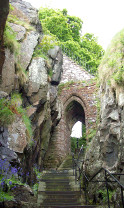
This time I'm high above the Clyde. I'm juggling high-level imaginary functions, overlaying maps across the terrain below, and trying to overlay some history, too. This big old rock I'm standing on was the center of its own kingdom once upon a time, a time forgotten by many people, a time that was not negligible in human terms, some seven hundred years. It was a little territory called Strathclyde, among other names, a start-up after the Roman withdrawal, and continuing on until the Scots gathered the momentum to overrun them. By then, this kingdom was among the last holdouts among the old Britons, along with relatives down in Wales. Set the stage after the fall of this rock for Braveheart and Robert the Bruce.

This rock is Dumbarton. It is one of those vestiges of ancient Scottish vulcanism, (some time before Braveheart … or his species,) a plug of cooled lava surviving the volcano itself, which was scraped away by the glaciers of the pre-Braveheart Ice Age. It's a somewhat ludicrous bit of rock rising suddenly from the silt of the river and from the flat lands close the river, a double humped beast with steep, unassailable sides, perfect for a castle. North of the river are some serious Scottish highlands sneering at the little rock from the vantage of a few miles. But the rock stands proud.

For centuries, it stood with its feet in the river, connected to the northern shore only by a narrow strand of marshland. In fact it was surrounded for some 320 degrees out of 360 by two rivers, one the Clyde, and the other, the Leven, which politely swings around the rock's western flank to empty into the Clyde and its estuary. Now the marshes have been filled in, and a straight road leads to a parking lot near the castle gates.

The rock-island has one small sloping meadow at water-level, facing out toward the river, where ships with provisions or troops landed in olden days. Now it forms the entrance to the museum that has been formed of the castle. Castle is a hopeful term. There's no real castle remaining, just the governor's house facing the riverside meadow, the fortifying walls along all the heights, a prison from Napoleonic times, and an arsenal on one summit that was bombed by the Germans, when this area north of Glasgow was busy building ships of war.

So, yes, I've made the monumental journey from one side of Scotland to the other. Glasgow and Edinburgh are less than hour apart by train, but they seem to represent the antipodes of Scottish experience, at least to listen to the Scots. I compare it to the cultural divide between Rotterdam and Amsterdam, though Glasgow – the analogue to Rotterdam in this comparison – is the biggest city in Scotland, rather than Number Two. There exists the same impression of one being the sophisticate and the cosmopolitan, while the other is rougher and more working class, more 'real'.

I admit that Glasgow has presented itself as a riddle to me. Where Edinburgh was immediately navigable, immediately likeable, accessible and attractive, Glasgow has seemed dark and lacking center. I don't know which way to walk on my first day. Though there are wide avenues in every direction, adorned with Victorian beauties in red and white stone, though one senses the Clyde just south as an organizing spirit, one never seems to arrive at any one quintessential spot that is Glasgow. In Edinburgh, one gazes up at the castle, one strolls the Royal Mile from castle down the ancient streets of old Edinburgh, one strolls the streets of New Town, where the social and the shopping life of the city are concentrated. In Glasgow, one takes in the notable architecture, spread evenly throughout the center, one discovers one street, another, one discovers an understated riverside district, and one feels uncertain.. Have I seen this city?

My first night is distinctly grim. It's another of Britain's mysterious bank holidays, and the town is so quiet. The rain falls softly; the skies are grey. Looking up, I can enjoy the beautiful architecture. Looking street-level, the place seems seedy. And no matter how many corners I turn, I never find a variation. I settle for an unadorned little pub where I can watch some Championship, or second level British football and eat what is a surprisingly good burger.

I'm on the highest of the two summits of the rock. The weather is perfect, alternating between high clouds and sun. Visibility is far and clear. The mountains of the highlands are etched against the sky, looking much milder than I imagine they are. I'm picturing history, picturing the centuries passing over the hills like northern clouds.

Sunday, May 26, 2013


Travelogue 499 – May 26
The Haul


You know I like the smoky, I tell the bartender. He nods. 'And which was the one you preferred, sir?' That was the Ten Laddies, I say. 'That's the one.' He is a young man. Though he has a baby face, a mop of red hair, round baby-blue eyes, and smooth freckled face, he can't be all that young. He says he's worked at Oscar's for eight years. And I would think it takes a number of years of even the heaviest smoking to get teeth like his. Despite the yellow he has a charming smile, which he flashes readily. And despite the hiphop slacker garb, he has a very polite and personable manner. Oscar's is a personable Scottish bar. Everyone is conversating, as my students in North Minneapolis would have said.

By the way, Oscar's is not the real name of the bar. I owe it to a man I never met to disguise its identity. See, I got a tip from a local that a certain local author likes to hang out at Oscar's, and so I spent an hour or two there on my first evening in Edinburgh. That's when Adam the bartender recommended a few brands of Scottish whisky. I've resolved to taste some of the real product while in Scotland. Among the Islays, Ten Laddies is the best. The smoky aftertaste is marvelous. Good call, Adam.

Tonight, the Ten Laddies is celebration. I have run the race. I have finished it. I have even matched my second best time. It was not easy. It was an achievement of will power more than conditioning, since I've had almost a month off. My body attests to it, surrendering itself to such a variety of aches and pains that I actually groan aloud when I enter Oscar's and see that all stools are occupied.

Oscar's is a tiny place. There is barely room for the grubby bar and a row of stools inside the door. There are a few bland breakaway rooms, but I'm not straying from the bar. The clientele seems to be ageing neighborhood types. The conversating is energetic tonight because of the match on the telly. This afternoon, the Hibs and the Celtics are meeting in the final of the Scottish cup. The Hibs are from Edinburgh, the Celtics from Glasgow. When I walk in, the Hibs are down 0-2.

One of the conversators is talking down the Hibs with wit and with some vehemence. He's keeping the locals laughing, even as he draws their playful scorn and insults.

My celebration is short-lived. I can only stand so long. There are thirty minutes left to the game when I arrive, just enough for the Celtics to score one more goal. There's a general dismissal of the local team among the drinkers, and they return to local topics.

I'll need some food. I'll need a chair. I knew I was in for some pain by the second mile. I could sense that I had the power for the race, but not the depth to do it gracefully. Muscles were tired. The old injury settled inside my foot, though with a dull rather than shooting pain. And the effort was all effort, little flow. That said, once I found the resolve to finish, I locked in and enjoyed. The sky was cloudless. The course led us under Arthur's Seat, and after Mile Four, we were running alongside the Firth, running into the warm sun. The sun was too hot for locals, and I listened to some complaints after the race, but it felt great to me. Until Mile Eight, I even entertained hopes of breaking my record. My pace was solidly ahead of record pace. After Mile Eight, I realized how sorely I needed that last month's training, how sorely I needed the flow and the grace. Rugged effort wasn't going to be enough. I finish.

Being solo on these race trips, I realize how some of the hardest work is post-race, when one must make one's way back to the hotel without a ride, without assistance or company. But in Edinburgh, they want to push the endurance test to its limit. There is a twenty-minute walk from the finishing area to the shuttles back into the city, and a good portion of the walk is uphill. Once back in town, I have another fifteen minute walk to the hotel. By that time, I am moving like the tin man after a month of rain. After a hot shower and some stretching, I'm ready for the evening.

'Next year,' I say as I wave good-bye to Adam. He winks and flashes a smile. 'Next year.' Go Hibs!

Friday, May 24, 2013


Travelogue 498 – May 24
The Hill


It's 7am, and I'm taking crazy risks. I can not be held responsible for my behavior at that hour. Don't tell me that I have no right to call an hour early when the sun has been up for hours already. Yes, that is indeed the case. This is the farthest north I've ever been on this silly planet, while silly Europe quickly closes in on summer solstice. It occurs to me I haven't seen the night in a long time, maybe weeks, retiring early, never rising early enough. I haven't seen the stars; I haven't seen moonlight. Strange.

Maybe it's the lack of quicksilver moonlight that has unsettled my mind. I rise at 7am, and I start putting on running gear. A part of me is anticipating some common sense, but it never comes. I leave the hotel in my running gear. I'm setting one hesitant foot in front of the other. I'm running. I pass down my block of Georgian facades, eventually circling around to the back of the hill, climbing its brick roads, its paths, climbing above the city until madness passes for an instant, and I stop at the hilltop, having suddenly achieved a perspective of the northern side of the city and of the estuary.

This is Calton Hill. It's always been here in the middle of town, in the middle of history, but its evident history traces back a few centuries only, and a quirky history it is here on Calton Hill.

I've traveled to the site of my race, unsure whether I'll run it. The foot is still pierced by a needle of pain, though the fiery heat of it may have diminished. Some days the pain fades to nearly nothing. I have had successful trial runs in recent weeks, and some that aren't so successful. I retreat from running to the cycle for days at a time. The night before my flight, I'm debating whether I board or not.

Some 200-250 years ago, the summit of Calton Hill became the playground of a generation or two of inspired city leaders who embraced the ideals of the Enlightenment and made them their own, imbuing them with qualities distinctly Scottish, pragmatic and utilitarian. Engineering, philosophy, high science, and architecture flourish. So does poetry. As the Scottish Enlightenment stretches in span well past the end of the eighteenth century, it should be said it acquires a rosy Romantic glow. Burns and Scott are set beside Hume and Smith and Watt as local Enlightenment figures, and during the monument fever that overtakes this generation and that sweeps over the summit of Calton Hill, these two Scottish authors inspire some of the grandest of the memorials.

The primary architect of the time is William Henry Playfair, himself the nephew of a prominent Enlightenment personality, the mathematician John Playfair. William Henry is fond of Greek motifs, as befits any artist with Enlightenment credentials. The Calton Hill monument to Burns is inspired by the Athenian monument of Lysicrates, circular temple of nine columns, tripod on top, etc.

My favorite is the incomplete national monument, which was designed to be an exact replica of the Parthenon, meant to commemorate soldiers lost in the Napoleonic wars. It is incomplete because they simply ran out of funding. Since then, it's been derided by some as 'Scotland's Disgrace', though I don't see that it lacks grace. In its unfinished state, grass gathering around its base, the stone colouring and weathering with time, the monument carries forward from its day to ours dignity and philosophy. It's a kind of riddle, perhaps only asking, 'What were they thinking,' but perhaps also, 'Why do we put stone upon stone?'

I've arrived at the top of Calton Hill, and without significant injury. I look out over the Firth of Forth on a sunny morning, and I ask myself, 'Why not?' I think I'll do the race.

Monday, May 13, 2013


Travelogue 497 – May 13
The Hump
Part Four


So our new bicycle has been impounded. I have unwisely challenged authority – parking in a pedestrian zone near the station – and so I've lost the bike.

This is Holland. When the cycle goes missing, I don't even think about theft. That's a novel sensation. It's so much more likely to be gentle authority. Anxiety is further blunted by the certainty that I'll be able to track it down via internet in a day or two. Indeed, within two days my bike pops up on the city website. 'There he is!' the beat-up Union standing in profile against a grey wall for his mug shot.

Even being stranded without a bike is the smallest inconvenience. A few blocks away, I catch the tram home. I probably make it home quicker. And I still have Jan's old creaker parked at home. That will be my transport for a few days.

I find the impound lot on the old internet map. It's walking distance, thankfully, up the local canal to the Spaanse polder, an unattractive little district, raised from the marches in order to serve as ugly repository for warehouses and shipping offices and city impound lots.

I welcome the chance to walk. In a city so transport-friendly, I rarely get opportunities to walk for any distance. I'm looking for chances to rehabilitate the afflicted foot. As certain as I am that the new king of Holland would not hesitate to run the quickly approaching half marathon – on one leg if he had to – my resolve has been severely tested. Every attempt to train has been occasion for more pain and for self-doubt.

I don the running shoes, and I set out. It's only a couple miles, maybe twenty minutes along the canal and then down the innocuous streets of the Spaanse Polder. It's one of those nondescript days, clouds high and temperatures just chilly enough to wear long sleeves. It might rain, but probably won't. Instead the skies indulge in the occasional harmless mist.

The foot is feeling fine. I'm encouraged. Though ... what are these other aches and pains? After months of steady training, the body has become used to it. Dropping the routine so suddenly throws the system off. Now just walking a few miles will trigger all sorts of knots and kinks. Age doesn't respond well to stops and starts, even as it necessitates them.

So again, I am forced to face the thing that can't be faced, a fate worse than having a bicycle impounded, a fate worse than cold rain while you're cycling into town. I would have to say it's worse than spending the day in Spaanse Polder. The thing worse than Spaanse Polder is a decision: must I, on my own initiative, cancel the race I've been anticipating for half a year, a kind of concession to age? I'm not ready.

The impound office is every bit as dreary as might be expected, as the neighborhood would suggest. But the staff greets me with a good cheer that admits none of it. There's no hint of the surliness or defensiveness that one would brace oneself for in America or Ethiopia. This is Holland, where consequence is a neutral and impersonal. Beneficial! Where would society be if we all parked on the pavements? What is democracy but a collection of fallible cyclists who make their mistakes and pay their fines? Life is wonderful. Do you have your claim number? Yes, I do, collected from the website when I found the mug shot of my poor machine. Good! I pay my fine, and I'm cycling home through a new rain in ten minutes.

Pedaling into the wind and the rain, I ask myself, will I make it through this awkward middle phase to my trip? And what will survive to the end of it?

Home again, and drying off. I stretch – an act of futility. I pick up one abandoned running shoe from the floor. Alas, poor Saucony. Etc. This is killing me.

Sunday, May 12, 2013


Travelogue 496 – May 12
The Hump
Part Three


The weather has turned, and emphatically so, as though in northern European renunciation of the soul-abasing luxury of excessive heat and light. The winds have picked up, and they blow the clouds forward in waves, relentless fleets to storm the beaches. The sun beams through the breaks in the rolling banks of grey conquest, teasing the soul so recently celebrating the graciousness of spring.

Cycling across town and over the Swan Bridge is a test of the will. The winds are capricious and strong. One might find oneself pedaling only to stay upright. I have an appointment at Stadion Feyenoord. It seems that the Secretary General of the Ethiopian Athletics Federation is in town. I'm to tour the stadium with his delegation, who are conducting research in preparation for final opening of a new stadium in Bahir Dar.

Kismet follows me with such steady devotion that I wonder if it is actually just the order of things. Was there ever such a thing as strange coincidence? Or does this simply describe everyone's life? We marvel over the crossing lines of chance, the events that defy odds and explanation, and maybe we separate them out. These things don't happen, we say. But they do, and maybe they happen with the same bizarre regularity for everyone, but we agree to share in head-shaking wonder.

I spot my crew right away. For me, there is almost no mistaking an Ethiopian. That may sound like a weak claim, identifying Ethiopians in white Holland. But Holland is not so white as it once was. And even among African races, I find the Ethiopian distinctive. Furthermore, I can spot an Ethiopian official with chilling accuracy. There is a look to them. I'm in a mood to be charitable, so I'll refrain from detail.

In this context, the officials are friendly enough, They are on a sweet little tour, Holland and then Vienna. The pretext is research. They have a newborn stadium project in their tender care; they want to nurture it properly. The architects are Slovak, and therefore the trip to Vienna. The trip to the Netherlands is a sort of sampling of facilities in rich and football-mad Holland. I find out quickly that there is no plan at all guiding the Feyenoord stop. Why I should have thought differently escapes me. Their guide is Mulugeta from Amsterdam. He buys tickets for the tour, and away we go.

Feyenoord is Rotterdam's biggest team. It is routinely one of the top clubs in the Eredivisie league, and it enjoys a wholesome, long and bittersweet rivalry with Ajax, Amsterdam's team, the way that the Dutch cities #1 and 2 have for many years. I think that – in the way of most #1s – many Amsterdammers would act very blasé about the rivalry. But not the Rotterdammers, stout city patriots. Their sentiments seems summed up best by an old saying that Rotterdam makes the money while Amsterdam spends it.

The name of the football club comes from a district of Rotterdam, properly spelled Feijenoord, that lies just across the river from the east side of the city centrum. In building the 'new' stadium (circa 1937) the team abandoned its old neighborhood but kept the name. The team still lives on the south side, but due south and about a mile from the river.

If one doesn't (a) get tingly standing next to the pitch of a legendary club, or (b) find some pleasure in a tradition of sports architecture and art, then a Feyenoord tour probably wouldn't be his cup of tea. But I will say there are some nice touches in the stadium: mid-century stained glass depictions of the towns round Rotterdam, funny artsy-cartoonish murals of football in action along the walls of the stadium bar (from 1961, if I understand my Dutch properly,) and odd 30s bits of sculpture here and there, kind of consciously clumsy in a vaguely Cubist way.

I have done my duty. I've met my high official from the national athletics federation. And I've had some fun in football reveries. I cycle back home through the spectacularly deteriorating weather, against prodigious blasts of wind – and I have learned living here that wind is really the defining meteorological phenomenon of Holland – and into the pinpricks of rain, pushing Jan's poor old nag of a bike to its limits, and I reflect that the cosmic WED, the hump, the unanswerable koan of this trip stretches on into mid-May.

Yesterday, one day after picking up a second cycle, in anticipation of Menna's arrival in June, I visit a busy coffeehouse in the vicinity of the central train station. I like this cafe for writing; it is – dare I say it – clean and well-lit. The floor-to-ceiling windows offer some of the best people watching. Travelers from all over Europe stop here between legs of their journey.

The station is a black-hole for bicycles; I should have known better. Train stations in Europe are generally centers of city movement and commerce. The bikes pile up around the station like apocalyptic detritus. There is no way that any Germanic people with self-respect would allow this mess to happen.

There will be boxes, defined by well-preserved white paint, within in one must park one's fiets (bike). The consequences will be … not severe, but certain – carried out with firm kindness, or kind discipline. I leave my bike carelessly, randomly, locked up by a pillar of the business highrise housing my cafe. I can almost see it from my window seat.

When I emerge, my new (used) bicycle – symbol of our future in gentle Europe – is gone.

Sunday, May 05, 2013


Travelogue 495 – May 5
The Hump
Part Two


The day comes, the perfect day for sitting outdoors at a cafe table for an hour in the late morning sun. I can't let an hour go without work, so I break out the computer. The spring air does wonders for my sight. I see right through these planning documents. I draw magical organizational charts. My memos are sparkling with insight. I have Ethiopia figured out at last and filed away in my hard drive.

When I should pack up to go, when the sun is becoming strong, when I feel my fleeting brilliance beginning to wane, I pause some moments longer, unable to let the morning go.

I'm sitting at table in Pannekoek Square on the east side of downtown, not far from the channel of the river that gives the town its name. It's a busy little square, surrounded by tiny streets and tiny shops. Judging by the clientele, I am somewhere near a hub of Rotte hipsterdom. The barista today is scruffy and sincere, a devotee of the blues. He swings his head in emotion to the beat of his cafe playlist. Behind the order counter are a few milk crates full of real vinyl.

Abstractly I watch the movement around the square. I contemplate my race, my injury, my bicycle. My bicycle is Jan's bicycle in actual fact, and a true and loyal clunker it is, grey and creaking and crooked. The brakes are squishy. Something rubs against the front wheel intermittently, and I can't figure out what it is. The seat is the popular European wide-body model, which chafes and restricts blood flow to some sensitive destinations. It's hard to get any speed going.

The injury to my foot has stopped me for a few days. But hope springs eternal. I have found myself unequal to the grown-up resolve that resigns to the interdict of Nature. The date of the race rushes forward to meet me, heedless of bruising circumstance. In my desperation, I turn to the resort of every true amateur: cross training. Only a few days after the killer run, I repeat the course, this time on Jan's bike. It is properly brutal. My foot aches, and I fight an unrelenting headwind the entire way out. I refuse to let up, pushing all the way out to the little wooden bridge that arches over the final canal before I stop by the stadium on the outskirts of Delft.

On the way back, I am able to ride with the wind, relax a bit, take a look around, enjoy again the felt tabletop terrain of old Holland, the delicate grid of small canals among the fields, the occasional group of horses, cows, or sheep, looking surreally robust after my years among their Ethiopian counterparts.

What have my cycle rides accomplished? This thorny philosophical question I turn over and over at my table in the sunshine. Where would I be if – wonderful meditations for spring days.

I do think about the new king. I ask myself, what would he do? Jan has thrown me with his acquaintance with the king, with his opinions about his character. But I must conclude, just because he is a king, that he would err on the side of noble persistence, of the college try, of the holding up the flag, and such concepts. I am briefly inspired. I think, at the end of the day, he must approve of this timely sunshine. These are my signs. What do they mean?

I have to report that I found no answer. And tomorrow, I will ride again, not out of considered strategy but from very human impulse and need to move once has gotten used to moving. We are profound creatures when all is said and done.

And so I must say adieu – or 'tot ziens' – to Pannekoekstraat. I must bus my coffee cup, and I must return to my life of diligence and effort. This is what King Willem-Alexander would do, in lieu of anything more concrete, that is. Back to the wars! Lo, trusty steed! Let us to the fight! And please desist that annoying squeak! It's just unseemly.

Saturday, May 04, 2013


Travelogue 494 – May 4
The Hump
Part One


I couldn't ask for fresher spring morning to be out and about. I'm cycling back from an early coffee break in town, coasting along on Jan's creaking old bike under bright blue skies, facing into a fresh breeze with only a hint of the old April chill to it. The city is peaceful this early on a Saturday; the roads and the bike paths (the fietsenpaden – one of my favorite Dutch words) are clear and quiet.

The camels are certainly content. One is rolling friskily on it side. The others are working their loose jaws on Dutch grass, contemplating their good life in Europe. They occupy a tight little meadow between major thoroughfares very near my apartment, confined within a makeshift corral next to the red tents of the circus. It's funny to me how tiny a space this circus occupies, almost as though this were one of its astounding tricks. Two tents, the camels, a few cows, and their trucks are all squeezed onto the slimmest margin of empty land, a very Dutch sort of sleight of hand. They don't set up in a park, or on a spacious plaza downtown, but here in the outskirts, on a neglected plot left without purpose. The camels don't seem to mind. They have room to roll about, stand, chew on spring grass, chew on philosophy. These are Asian camels, woolly and double-humped.

I suppose the occasion for this circus visit was Koninginnedag, though they are still setting up on the morn of the big day. What, you may ask, is Koninginnedag? That is Queen's Day, a much-beloved annual holiday in Holland, always on April 30. Great timing for celebration, if every year's spring is as sparkling as this one. This year's Koninginnedag happens to the last in Holland for a while. The reason is, Holland is losing a queen. This year, Queen Beatrix, queen for 30+ years, will be resigning in favor of her son, Willem-Alexander. W-A will be Holland's first king since 1890. In a sort of actuarial miracle, the Netherlands has had exactly three monarchs since 1890, all women of extreme ruddy health.

The new king is in his mid-40s. He's precisely the age of my landlord, Jan, with whom I celebrate Koninginnedag, meeting up for beers at the festival in the park in front of his house. Jan is the sort of bourgeois leftie that I enjoy. He lives in a gritty neighborhood, and hangs out in the biker bar, completely content in his unaffected way, his look at stark variance to the scene, something like Apple meets Carnaby Street, good-looking and composed. Oh yeah, he's met the new king before, at parties here and there.

He says about the king that he was always soft. He needed to toughen up. His mother and the queens before her were tough, so he says. I sense there's something more there, but our language gap stops us in our analysis at 'soft' and 'tough'. Jan seems to have run into an unusual number of Dutch celebs, but I guess that's what it's like living in a small country. He has a story about being assaulted late at night some years ago by a soccer star at the height of his international fame and powers just now. I've heard a few stories about this guy since I've been in Rotterdam, a guy I'd always thought of as squeaky clean. I suppose it's a part of the soccer culture to prove yourself the tough in youth.

I'm halfway through this trip away from Ethiopia. It gets lonely. One wonders what one's mission is. One of my missions was to be training for my next half marathon, coming up at the end of this month. But Fate had its own plan, Fate and my own excess of zeal, my hubris. The new king, I'm sure would concur: one must know one's limits. Hubris in amateur running is over-training.

My chastisement comes on the day of my longest run to date, a week ago or so, right at the furthest point from home. The thunder bolt strikes as I approach the stadium at the southernmost edge of Delft, just as I am about to turn round for home. It strikes in the left foot. It's s subtle strike, though, and I don't take it seriously. It's a pain that has to settle in and pitch its stubbornness against my own. I run most of the way home, though monitoring this new burden, this barbed message from above. And at last, I have to give in and start walking. Running with a limp is no good for any part of the body. I walk the rest of the way, along the canal. The sun is out; I can't complain. But I'm sad. The race that's been so vivid in my thoughts, now looks to have been a fleeting light, like the glints of spring sunshine in the waters of the canal, though even less tangible than that.

Yes, this is the hump week of the trip, in more ways than one. With my limp, and my missions all halfway up, halfway down, with work accumulating like winter snows back at the door again, after weary weeks of tinny Skype meetings with my one and only, this is surely hump week.

Thursday, April 18, 2013

Travelogue 493 – April 18
Winds and Wins


The book is a slow kill, irresistable in its craft but relentless in the methodical torture of its protagonist. I can't put it down, even as it drags me into dismal thoughts. The author is a master, making you laugh as the man drowns.

It's a beautiful evening, at least it if you're inside the Wester Paviljoen, having a strong Belgian beer and gazing occasionally out the plentiful windows. The sun shines insistently on the intersection outside, the confluence of several gently curving Rotterdam streets that are lined with rare, historical Dutch brick – rare for poor firebombed central Rotterdam, home of Erasmus before Amsterdam was more than a tawdry wannabe port, – the confluence of two streets that just here, as they cross, discover themselves as chic, like teenagers awakening one day to their cool. Once upon a time, the old Wester Paviljoen stood outside the walls, on the dirt road to Schiedam.

The sun is shining, so spring-struck Rotterdammers have flocked to the outdoor seating at this and other cafes, even as gusts through at speeds up to 33 mph. I've already been out trying to run, and it was ridiculous. I sit inside and survey their smiling ranks, sitting at the rows of tables, most of them turned toward the sun and toward the street.

I laugh as the man drowns, but I only speak metaphorically. The man doesn't drown; his downfall takes longer than that. I can laugh because the author is Evelyn Waugh, a master of language both beautiful and amusing. The protagonist is losing his wife to a silly affair, and as the marriage unravels, so do both their lives.

I have to lighten the mood of my reading. I'm in the midst of four books, by authors Waugh, Carey, Larsson, and Coetzee. The tally of disaster is considerable: grieving lover, discredited academic whose daughter is raped, girl murdered by her cousin, man losing his wife and home. It gets to you. How many distressing narratives do we take in on a regular basis?

What does a man have when he's far from home, and far from his wife, other than his entertainments? I enjoy the Wester; I enjoy my books; I enjoy the movie theater. Arriving from Ethiopia, these are the primary pleasures: food, access to books, and movies on the big screen. I'll see whatever is in the Imax theater at the Pathe multiplex downtown. Sadly, the latest was a Bruce Willis vehicle, and I'm reduced to a similar sentiment for his career as I have for Waugh's character. I'm not sure what selection process he goes through with his agent, but it seems to me that process needs some tweaking. From recent evidence, I'm thinking that the only criteria in play are that he gets to hold a gun and that there is something vaguely patriotic or vigilante to the story, and I do think those latter two qualities do blend or fuse for Bruce. I'm not sure. Either way, I'm thinking there is more to the forming of stories than vengeance served, and there could be more to his film career than weapons catalogues.

I won't complain. Bruce won the day for me. I enjoyed my popcorn and the big screen sound and fury. And today, the combination of sunshine and Waugh's magic with language is a wholly satisfying one. It's the simple pleasures that do it, like spring arriving in tired old Europe. Every time it happens, the chairs appear on the pavements, and the patrons are quite happy to fill them.

Wednesday, April 17, 2013


Travelogue 492 – April 17
Profiles of Great Americans


There's a bar with a TV down the street from where I live. It takes up the bottom floor of a corner building in the pretty Delfshaven neighborhood. The buiding itself is historical, and very Dutch, with stepped gables and a brick facade, alternating in dusty red and white, two little tin witch's hats.. The bartender is familiar with me. He knows I'll ask for Chelsea, and I know he will make a face. Chelsea is not a club he favors. But he changes the channel.

Today they are playing Fulham away. It's Chelsea's day. By the half, they've scored twice. One goal is a wonderful kick by David Luiz from at least thirty meters out, sending the ball sailing into the top left corner, past the outreached arms of the goalkeeper.

No scene like that for Fulham, not with Petr ÄŒech on duty for Chelsea. He is in top form today. Fulham has a corner. The ball curves into the crowd in front of the goal, and for a split second one sees only ÄŒech's arm, thrust forward overhand to punch the ball out of the fray and upfield.

He has a rocking stance before the goal that appears awkward, like the kid who has grown too fast and doesn't know what to do with his limbs. But he is all grace and self-assurance when the ball comes near.

Mr. Čech was born in 1982 in the town of Plzeň, in what was then Communist Czechoslovakia. Plzeň is a pretty town, west of Prague, not far from the German border, one of the largest cities in Bohemia. And, it need hardly be said, it is the origin of Pilsener beer.

Čech started playing football at age seven for Škoda Plzeň. He played as a striker at first, but soon found his niche as goalkeeper. Before joining Chelsea in 2004, he played for FK Chmel Blšany (1999-2001), AC Sparta Prague (2001-2002), Stade Rennes FC in France (2002-2004).

Honors and records: Voted into the all-star team of Euro 2004 after helping the Czech Republic reach the semi-finals. Best Goalkeeper in the 2004–05, 2006–07 and 2007–08 seasons of the UEFA Champions League. Named in the FIFPro and UEFA Champions League teams of the season in 2006.

ÄŒech holds the Premier League record for fewest appearances required to reach 100 clean sheets, at 180 league appearances. He holds a Czech professional league record, no goals in 903 competitive minutes. During the 2004–05 season, ÄŒech went 1,025 minutes without conceding a goal. He won the Golden Glove in both the 2004–05 and 2009–10 seasons. And so far, ÄŒech has kept 139 clean sheets for Chelsea.

Not bad for the boy from Plzeň. When I asked him for comment, after the Fulham game, he modestly answered in his soft and accented voice, 'Perhaps you know already that my surname "Čech" means "Czech" in translation.' I said yes, I did know that, Petr. And he added, 'So that my situation is approximately the same as that of our doctor in Chelsea whose name is Bryan English.' Picture me nodding, yes, yes.

I ask him about his homeland. 'Almost everybody knows the Czech beer, our product number one, we have very attractive models who manage to assert abroad.'

Okay, so I haven't met Petr ÄŒech, and I only know he has a soft and accnted voice because I've caught BBC videos of him commenting on games. And maybe the quotes above are lifted from the diary page on his website.

But I know we will meet one day , and I will buy him a pilsener, and he will tell me more about Czech models. I'll tell him I'm his biggest fan, and by the way, also a product of Czech blood and heritage.

Until then, huzzahs today's for Petr ÄŒech, shining example of Yankee ingenuity and perseverance.

Tuesday, April 16, 2013

Travelogue 491 – April 16
The Marathoners


The day before the Boston Marathon is the Rotterdam Marathon. I make a point of stopping by the start, watching thr runners go by. I've missed the first of the pack, the elite runners, but I stand there for ten minutes watching hundreds and hundreds of runners go by.

It's strange that I had read somewhere in the past week that the Rotterdam Marathon was the biggest festival or gathering of people for sport in all the Netherlands, and I had registered at that a slight twinge of dread. I wonder if any Dutch readers would have felt apprehension. Or perhaps it's a particularly American reaction, the expectation of terror. I envy the Dutch, if they can go to a festival like this with only anticipation and pride in their hearts.

The Rotterdam Marathon is truly huge. It takes over the center of town. And I see neither the beginning nor the end of the stream of 'competitors'. These are the mellowest of competitors in world sport, marathoners. Their only aspirations are to finish and to have fun among the thousands of their peers, to enjoy the sense of belonging to something big and noisy and fun for a day. Their only rewards for hundreds of hours of training are pain and a medallion. They travel from all over the world for that. And for the party.

It is a party. The noise at the starting line in Rotterdam is terrific. Speakers are blasting music to inspire. Fans are cheering. An announcer is babbling on, narrating and commenting and encouraging. It's about the noise, and about being together.

I'm wondering as I watch why we all love this so much. And I doubt that it goes much deeper than what I've said, the noise and the camaraderie.

I've been chatting up foreign marathoners that I meet in my cafe. The day before the marathon I met two Irishmen, part of a larger group who just ran the Paris Marathon, then jumped on cycles to make the four-day trip to Rotterdam, only to run in the Dutch marathon two days after their arrival. They are raising money for a children's hospital: challenging themselves, challenging others.

I'm in no shape to run a full marathon, and I have my sights set on the Edingurgh Half next month, anyway. But I did sign up for Saturday's 5K on a whim. If I was looking for a grim reality check on the state of my power and speed, I got it. My performance was an embarrassment.

But, of course, if the performance were the whole of it, very few of us would be out there. No, the joy is in being among the crowd, lost among the mass of people like ourselves, under a big morning sky, everyone jumping up and down to keep warm, everyone having a laugh. The gun sounds, and the mob starts churning, moving forward. It's exhilarating. Later, most of us laugh about our performances, rather than boast or even complain about them. It's a pretext, an excuse for having our time, time for a time.

The day of the Rotterdam Marathon is suddenly warm. All week the weather had been constant, a bit chilly, a bit wet – perfect running weather. Then suddenly, it's sunny and muggy. That lasts just one day. This throws the runners from places like Ireland off their game. I encounter a different set of Irushmen in the cafe on the morning after. They smile and shrug. 'No record this time, that's for sure.' They have bags packed, ready for the train to the plane to the coach home, and they'll be ready for work on the morning after that. They did the other way only the day before the race.

After watching the race-day festivities a while, I return home. The morning is building toward a beautiful sunny afternoon. I want to celebrate the occasion, celebrate the runners. I suit up, I put on my running shoes, and I head out for a long one, following the canals north, out to the edges of the city, where I see elderly couples out coasting on their bicycles and smiling, where I see young girls out riding their horses, where I see other runners. Whenever we runners pass one another, we smile and hold up a hand in greeting and salute. Good to see you.

Thursday, April 04, 2013

Travelogue 490 – April 4
Cold


There's a light snow in Rotterdam this morning. It has been sent by the gods to taunt me, to remind me that I cheated winter by retreating to Ethiopia for one month. I must pay what is due.

My first night in Europe I spend in Frankfurt. Not in the city itself but in the sprawling environs of its huge international airport, proud hub of Lufthansa and the busiest airport in Germany, staying out where hotels dot the anonymous, circling service roads, roads that run round the runways like dogs behind their fences, roads that slice through tame stands of forest.

I see these odd forests from the plane as we land, partitioned very neatly between bare deciduous and dark evergreen, making for a nonsensical patchwork on the rolling hills roundabout. These look like timid forests, kind of anemic and spindly, and while we are still far from the Black Forest, I expect more confidence from the trees, more somber gravitas. Certainly, they have been granted the respect of a fair bit of land so close to the big city and the bigger airport.

I decide I must inspect these spindly specimens of the not-so-Black Forest. Unfortunately, I decide to inspect them first thing in the morning, dressed in running gear that I discover far too late are inappropriate for the first of April in this part of the world. By 'too late' I mean just as soon as the hotel's automatic doors have shut behind me. The doors are glass, and I feel the eye of hotel clerks and idle hotel patrons on my back, issuing sighs of wonder at my bravado. I can't turn back. I launch in, and as soon as I'm beyond the shelter of the building, I discover the even colder wind. I must see this through. My eyes are tearing up; I'm at a virtual stand-still in the wind; skin cells are screaming. But I tell myself I am demonstrating real heroism.

And besides, it's not that bad. The shock fades, and the sluggish blood finds it courses, and I find some comfort creeping out from the heart to the limbs. I pass some more hotels. I pass a warehouse for airline food – this must be where all flavor is leached away. I take a turn and cross over the highway that leads to the city center. And on the other side, I come to my first stand of noble forest. What I discover there is something much more pleasant than what it seems from the air. It's parkland, cut through with silent dirt roads. The trees manage a bit more grace on the ground, despite the indignities of winter. And for the moment, I'm very content, running through this German forest early one cold morning. The chill is a part of the scene, enlivened by the gathering light of day, moving like the breath of the venerable woods. I return to the hotel in triumph, foregoing the quick and humble entry indoors for a round of stretches performed on the pavement outside.

And once I've showered and eaten, once the heroism has been packed away among my more mundane possessions, it's time to begin the journey home to Rotterdam. It will be a half day's ride on two trains. The airport has a station, and I catch the train north from there, passing through Köln – where I get to catch a glimpse of the great cathedral while we pass over the Rhine – and through unpronouceable Mönchengladbach; soon after crossing the frontier near Venlo, where one tricolor gives way to another, and where I start seeing that funny old Dutch language on street and rail station signs.

And now I'm back in R'Dam. I stare out the window forlornly every morning, realizing that spring is rebuffing me. I have not paid winter its dues. I have cheated Minnesota of its March crescendo, and the Fates will not be denied. There was a certain amount of chill I was meant to absorb, and absorb it I will. I dress for the bicycle, and out I go, into the freeze.

Saturday, March 30, 2013

Travelogue 489 – March 30
Is it Mary or Mars?


It's Maryam. Today is the 21st of the month in the Ethiopian calendar, and the 21st is always Maryam. No matter what the month, it's the day of Mary. The road up to Entoto, and to the church of Entoto Maryam, is full of pilgrims walking up the mountainside, some already walking down.

In America and Europe, I like to be up with the dawn. In Ethiopia, this pattern doesn't hold, and I get to blame my wife for that. The country may be jumping by sunrise, farmers working, laborers halfway through their long commutes, and the devout of both Musim and Orthodox stripes wrapping up their prayers, but Menna cannot be moved until the sun has established his claim over the day, well beyond the reach of the tallest mounts of the highlands.

The sun is shining brightly by the time we head out for my last Ethiopian run of the season. I head out for Europe tomorrow. I want one last long run to tire me out for a deep rest tonight. We start up the hill and find the road beset by the pious,walking with the patience of the Virgin up the long road, couples with grandparents, with children, all cheerfully hiking.

Up top, the field of dust in front of the church, where we usually warm up – often mimicked by a circle of small children who might be from the village behind us, or might be beggar's children – the field of dust has become a colorful parking lot, filled with the cars and taxis and vans and the festive buses of the more well-to-do of the religious. The perennial host of poor and disabled has swelled to great numbers, as have the numbers of church-day vendors, selling the long orange church tapers and sacred texts and pictures of saints … and shoes.

Tesfahun and Fikre and I set out, leaving Shimeles the driver to find some shady spot for a nap. We are soon beyond the reach of Mary. While I still have breath, I pump Tesfahun for soccer news. He continues to contend that Mourinho will come back to Chelsea. Don't place any money on that. I taunt Fikre by asking whether today is Maryam or Muhammed. I get these Ms all mixed up. Madonna? Mubarak? She doesn't find that very amusing.

Soon enough, the real athletes need worry no longer about the nattering of the false one. My breath and my concentration are absorbed wholly in keeping up. A big race approacheth, so I have renewed commitment, if no new speed. We're putting in ninety minutes today.

The small rains have passed. The clouds linger, this being our slow-moving highland weather system. Full days of sunshine will be a while in returning. The trails in the mountaisn have dried, though it's still early for the dust to fly. There are spells of powerful sunlight to dapple the packed red earth of the forest floor. These are not bulldozed and raked woodland trails . One lets one's eyes stray from the terrain at one's own risk. The sharp light and shadow of a sunny day can dazzle just enough to lose an ankle.

Tesfahun likes to lay the most tangled lines among the trees and gullies as he leads. It tests all my feeble powers of concentration, and quite a few feeble muscle groups, as well. Rather than follow the lip of a steep gully, we bound down and up again, seizing all spare breath like a punch in the gut.

The dancing steps among roots and rocks and fallen branches and rising shards of tree stump can be fun when you're full of life and breath, but when you're winded and fatigued, it takes everything you've got. I charge the side of the gully, choosing each step with all the precision possible in a split second of decision, planting my toes between thick, twisting roots, on a few inches of horizontal earth jutting from the gully wall, on the flattest stone among a pool of them. Having to plant and turn, I catch an old, stray goat skull with the heel of my back foot, and send it tumbing down into this little winding crack in the hillside.I have no time to look back or to apologize to the long-since-dearly-departed. I must keep going I make a note that I must offer a goat's prayer at Maryam. Or was it Merril Lynch, or
Mississippi, or Lionel Messi?

Sunday, March 24, 2013

Travelogue 488 – March 24
The Drive


It's a training day. Since last week, the small rains have moved in. The stones of my little road glisten with the most recent downpour. It's a short cimb up to the asphalt road, stepping on flat stone after flat stone, laid in a pattern I must unconsciously know by rote. I'm in shorts and running jersey. Years into this ritual, there are stil people who stop in wonder at the sight of me. I pass under the windows of the Yerusalem school. Some child shouts out 'Faranju!' I'm proud to note that the 'u' at the end denotes 'the' Faranj. They know me.

Weather moves slowly in the highlands. A pattern is set, and the days look the same for five days, two weeks. First the clouds darken at the close of a long sunny day, accumulating over the mountains. The next day the clouds gather again, and this time there is a sprinkle in the northern neighborhoods. A day or two later, there are showers of significance during the night, iron roofs resounding. And after that, the showers come regularly, clouds forming and breaking on their slow and unrelenting timetable.

Today, the clouds have broken some time before dawn. The road shimmers with damp. Shimeles moves quickly up the Entoto Road, past the U.S. Embassy and into Shiro Meda, three runners in his taxi. I'm in front. Fikre and Tesfahun are in back.

Shiro Meda is a northern district of Addis Ababa, dating back to Menelik's glory days. Shiro Meda is a crossroads, where another northern road, the one from Menen, empties into this one, where another road leads down the hill behind the embassy, and once led to the first of the Tesfa schools. Shiro Meda is a market. Past the intersection the gebiya starts up, the long line of stalls on either side of the road selling traditional Ethiopian clothing, beads and jewelry, the classic clay coffee poots, Marley T-shirts.

The road narrows, and the crowds increase. Some are shoppers, milling absent-mindedly by the stalls. More are pedestrians making their way down the long hill. Since before daybreak they've been streaming down this hill, some all the way from Entoto, making their way to jobs and classes and church and market.

There are several primary schools in the area. On weekday mornings, you will see young crossing guards in uniform standing in the zebra crossings. They look to be ten to fourteen years of age. Their uniforms are smart, with the reflective white stripe across the belly and peaked hats. The boys seem to have been instructed properly in all the essentials of the post: posture, the straight arm stop, the flat palms, the sharp bend at the elbow beckoning forward. I'm missing them this Sunday morning.

Our little blue Lada bobs and weaves at Shimeles's hand, swinging back and forth among the throng. School boys walk arm in arm four across at the side of the road. We miss one by inches. An old man is jogging down the hill, straying deep into the road in order to avoid the crowds. Shimeles sounds the horn and swerves around him.

A puppy is not so lucky, leaping out into the taxi's front fender. Shimeles doesn't pause for a beat. If I didn't shout a late warning and then look back in concern, it might not have occurred to the driver or the runners to spend a second thought. We look behind at us at the prostrate little tan body. A larger dog is sniffing tentatively over it. And then the scene is gone.

Higher up the hill, the crowds thin, but there are new hazards. Here it is the exigencies of commerce, the trade in wood and tinder from the eucalyptus groves on the higher slopes. Donkeys laden with wood come trotting down, drifting into and across the road, two or three or four at a time. Their shepherd jogs behind, switch in hand, country woman in a tattered dress and a blanket wrapped round her head, or a man in an ancient sport jacket and baseball cap.

Further on, it will be the women carryng wood on their backs. They can take up quite a bit of road, with the huge bundles of branches across their shoulders, some a good several meters long. Every morning, these women sweep the mountains clean of branches and leaves, bundle them up and carry them all the way down the mountain. Shimeles gives each a head's up with two toots of the horn.

By this time we don't pose much of a menace. The taxi, which bears the name 'Itchy', has slowed down to a crawl on the steep incline. Even without hitting the brakes, the most damage we would cause would be to gently knock one of the wood-bearers back onto her cushion of leaves. But we slowly pass instead, Itchy growling at them as we do.

Saturday, March 23, 2013

Travelogue 487 – March 23
Wheezer's Plaint


Wheezer the dog has taken to growling spontaneously. He will take it up in the middle of the night, starting slowly inside his cell, like an engine warmng up, and then raising the volume up to the threat of attack, sometimes climaxing in a bark or two, and then letting it subside. Fifteen minutes later he will start up again. The song doesn't vary much. Same lyrics, same tune. Wheezer's companion in the next cell doesn't respond.

It's after midnight. I can't sleep, and I don't want to wake Menna, so I'm lying on the couch in the front room, hoping for the best. This puts me closer to Wheezer and his voicings. The front room has a door of iron and glazed glass, set among windows that are the same. The iron doesn't meet the tile floor. So there is free access to ants and breezes and dog song.

'Wheezer! Shh!' He drops his voice momentarily, more out of curiosity than anything. I watch him in the light of the courtyard. He's licking his paw. I think he may have hurt himself, maybe on the metal water dish that he was clanking about with crashing fury earlier in the night. 'Wheezer, it's okay.' A few minutes later, he takes up his growling song again. I try putting a pillow over my ear.

Wheezer seemed okay a few days ago, when he was allowed to run the courtyard while Atomsa cleaned his cell. Wheezer's companion is more personable. After the round of pee stains, he likes to dash up to me as I stand on my front steps and wriggle his body in playful joy. Wheezer is more circumspect when he's let out.

Both dogs are squat and red-haired. Both have snub snouts and round, brown eyes. But Wheezer has a dejected air. He hangs his head and looks at you askance. His coat is in poor shape, faded chunks of it hanging from his side. On his better days, he approaches and seems to think about playing. I want to sneak anti-depressants into Wheezer's food.

Now he raises his song of despair and resentment into the night. Other dogs respond from other compounds. But otherwise there is no one to listen to his protest but me. And even me he can't keep awake all night; I drift off eventually. The reaches of night are indifferent.

In the morning, I am reminded that it is the weekend. We share a wall with the next door neighbor. This dark and rotund man has been improving his property by centimeters since before I moved in, occasionally picking up the hammer to bang on our mutual wall in a tattoo of frustrated middle class desire. I … want … a … pretty … little … house. …. I … want … a … pretty … little … house …. He fiddles with the corrugated iron roofing. He'll erect wooden framing for tiny rooms that will make the place complete. He piles trash against the wall, and rests for weeks at a time, and then he will start again. I'm … a … man … of … conse … quence ….

And so the weekend begins, echoes rolling through my head of animal complaints against the lesser fates. Wheezer is quiet now, lying his head against the cage's door. He rolls an eye toward me. He twitches an ear against the intrusion of a fly.

Saturday, March 16, 2013

Travelogue 486 – March 16
Brown


It's the season of flies in Ethiopia. The air is warm and breezy. You sit outside in the sun, and are reminded why it's best not to sit in shorts. The flies circle and land, circle and land. Wheezer the dog can't sleep; he has to blink away the pests. Windows and doors are open at almost all hours.

Indoors, the flies buzz in twos and threes. You can't keep them out. Wave them off when you try to concentrate. Wave them off when you eat. Wave them off in bed, until you get angry and stalk after them with one sandal on and the other in hand. Little corpses lie in corners until tomorrow.

The skies are persistently bright. The streets are dry. The dust flies high when one steps in it. The neighborhood has a summer feel. People are cheerful, their shouts and laughter attenuated by the sun and the dry breezes. They move with leisure, each step distinct and carried through as an act of will or ceremony.

The colors of the land have blanched, the greens become dusky, the browns yellowed and chalky. The distances below the city resolve into a tawny, smoky bowl, quiet and timeless. The meadows in the mountains are brittle and yellow. They rest among tracts of dark woods that have almost no color to them. Inside them are dusty shadows.

There is rarely water in the tap these days. We leave the faucet turned on in the kitchen when we're home. Once in a while it hisses with a burst of unproductive pressure. Then it gurgles noisily, and Menna and I sit up straight. There's a tentative rush of water, and we hold our breath. If it holds, one of us dashes to the shower. After cleaning up, we fill buckets. Bucket water is for washing ourselves during the days in between. It is for washing dishes. It's for flushing the toilet.

I'll sit outside on one of my durable little wire and metal stools. I like the summer skies, their pale blue calms perpetual. There are clouds, but the intermitent and peaceful sort, intent upon their plump dignity only, pursuing no haste. Wheezer the dog stares at me sorrowfully, blinking and twitching away the flies.

Sunday, February 17, 2013


Travelogue 485 – February 17
Iowa


What do I know about our neighbors to the south? It's a territory I have no images for. I have traveled the state's highways in days long past. I remember long ribbons of asphalt and the white dotted lines. I remember farms, but quite possibly only as an abstraction, as stock images borrowed from magazine ads.

Now I'm driving down Route 169 and leaving the Twin Cities, on my way to our neighbors' territory. I don't know what to expect, at least beyond the familiar gauntlet of suburbia: first, the suburban highways that flow like bobsled chutes. There is no view from their privileged surfaces, if one were to have the nerve to look away from the swerving game of tag. There are only glimpses of stands of evergreens, planted in lines, or of square-edged masses that are the habitations of commerce, or of the cartoonish signs indicating major malls, space opening around these malls like the pall of battle or the long sleep afterward.

From inner ring I pass to outer ring. I seem to be passing in and out of these outpost communities: just when a snow-covered field says country, a tract of steady-beat housing appears, manifesting its own sunshine strip malls. Just as quickly they're gone, retreating before the snow-top pasture lands again.

One of the last stands of Twin Cities culture are the twin establishments of the race track and the amusement park, both silent as the sets of failed films, pushed down into a crust of snow. Past them, I am free.

I am following the Minnesota River Valley. This bit of the journey smacks of the rugged, of the bare-faced rock among the snow. The Nissan and I are clearly descending through a pass of sorts, with the river lending company and guidance on the left. Horizons are tight. We might see, my steed and I, across the surface of the wild river – wild with ice and wild with black waters fighting against the dying glint of the white – we might see across waters and into the woods, but it is the season of sight, all trees bare and standing tense sentry. On the right side are the short and stern daddy walls of geography. We wind breathlessly down into vales, my Nissan and I.

St. Peter comes to us, bluffs running parallel to us at a stately distance to the west. Structures folded from the prolific essence of high grace, clearly academic or religious, judge us from above, judge the pioneers and settlers, the drivers of paltry Nissans. South of the Saint stands Mankato, occupying a stark, bent alley that encloses the river among ten miles of snowy shelving. The town boasts its vestige smokestacks, its university, its line of antique brick storefronts turned to bars with a dress code that mandates grease. Long-hairs stalk in temperatures dipping, today steadily dipping.

The Minnesota River breathes. All the town's buildings exhale in clouds of mist. Vapors rise gently above the river valley.

Hereabouts, I catch Route 60, toward the west and south, toward the state line.

The next saint is James, and beyond St James on my new country route, like a temper melting in distraction, the land relaxes and opens into long views. My Nissan sees suddenly distance, curves gentle and rather vertical than slithering horizontal, over mile-long bows in the land, each generous enough in description to allow projection of farming plots over every hectare. The snow stands shallow, in sly and tacit acknowledgement of temporality, over each fertile field. And the Nissan hums.

Now change is a quality measured in fine doses. Farm fields spread in confidence over the land. Horizons open up. Nissan and I enjoy the sight of farm houses and archetypal red silos. Towns access the highway on slanting roads, and turn a commercial face toward passing travelers, in gas stations and apple pie diners and tractor dealerships.

While Nissan and I share a few chuckles over weekend public radio, the miles clock, steadily burning our fuel. We are isolated from the biting winds behind glass, and behind speed, a tiny and subconscious part of us continually praying for the genius of automotive engineers. Climate control whirs below the voices of radio personalities. Nissan and I are having a pleasant day.

The snow on the ground begins to dissipate, freeing the varieties of brown underneath, the grasses and the cold earth. And suddenly there is the border, and the markers among the spacious fields, cheery welcome signs in the awkward shapes of their states, seem like mild satire engineered by the guys on the radio.

This is Iowa! The lands themselves could hardly be more hospitable, opening up their miles to the travelers without impediment, without reserve. 'Here is our corn. This is our sky; you can see for yourselves how it is. Sometimes it is wrathful. Mostly it is kind. Look up and it may not seem like you are moving, but you are more Iowa every minute.'

Monday, February 04, 2013


Travelogue 484 – February 4
What's My Name?


He's a big man. He occupies half the seat beside him on the bus. He speaks into his cell with a genial smile, making plans for the evening. 'I work in the morning,' he informs us all. 'So I can't be at it all night. You know what I'm saying? … What they all over there doing? … No, baby, I've got plans.' He negotiates. 'OK, I can come by at 8 or 9. … Oh, that's not good enough.' He's laughing. He stares straight ahead blandly, while passengers board and squeeze by him down the aisle. 'I bet you don't even remember my name,' he says suddenly. 'What's my name?' The bus shudders forward, moving down Nicollet in the direction of the river.

The bus becomes crowded. It always does in the blocks between Tenth and Seventh. There are a lot of connecting lines here. Everyone is bundled up, they waddle down the aisle, edging sideways by the big man. He doesn't see them. His gaze seems locked on some pleasure in his near future. It's an innocent pleasure, to judge from the openness in his expression. His voice carries above us all, above all the shuffle of travel. He hums from time to time when he isn't talking. The mob duck-walks off again at Seventh and Sixth. The big man stands.

He stands beside the bus driver, who is a white-haired white woman, and he asks what the next stop is. She answers quietly. He wants to clarify: 'That one there?' pointing ahead. 'That's the next stop,' she says. He's content with that. He relaxes, leans against the pole and smiles. 'Where are you watching the game?' he asks her. She demurs. 'I'm not really a big football fan.' He stands up straight. 'But this is the Super Bowl. The Super Bowl is like, is like Christmas or Easter.' He grins scans the seats nearby for support. One old man is game, nodding and laughing. 'Right? Everybody is partying. This is like the biggest day of the year for guacamole and chips and ... water.' He's full of love for his country. “That's no lie.' The old man is bobbing his head gleefully.

I'll be watching the game at Steve's house. Steve lives in Fridley, up snowy, anonymous highways north of downtown. Minnesota is humble. It is flat; it demonstrates no distinguishable features. We might be driving anywhere. The purpose of life might well be movement, might be macadam, might be the purchase of fuel. The most brilliant places en route are the fuel stops.

We will arrive. Steve has a refurbished basement. He has a sixty-something inch screen. But these are only excuses for gathering. Here's what Steve really has. He has a three year-old boy with a voice like brass. He likes to run at full speed and dive head first into the sofa cushions. He has a neighborhood deli that delivers huge calzones and french fries that stay soft long after they cool. He has a huge tub of ice cream in the refrigerator. He has a mother-in-law that always, always has a new method for divining the future. Today it will be the reading of poker cards, according to a book that assigns a card to one's birth date. I won't divulge my card, but trust me, I am made for great things. The older I get, I'll be wondering more and more often when those great things will arrive. I'll be anxious about them, like I might be about a child late home from school. Unless the movies have always been right, the great things are under my nose, etc.

Steve has cable; Steve has remotes. When the action on the field slows, when the lights go out, we will turn the channel to the Puppy Bowl. This will annoy Steve to no end, and we will find that hilarious. We will manage to catch one puppy touchdown, a chew-toy tug-of-war between two tawny-hides on the felt green pitch. I will be thrilled. But even better will be the kitty half-time show. I will be reminded that there is something merciless about the kitten, a ruthlessness cloaked in its cuteness, like a blade handled with calculated carelessness, making that initial incision in a trice, in a lapse of attention. We will be slain, laughing while Steve glowers.

Returning to the game, we will see the promise of great things in Buttercup. That's my placeholder name for the quarterback of the Niners, until I master the more challenging true name. And we will learn that for some there is indeed a dignity inside losing, when one has precociously arrived too soon, when one has drawn just the right card from the poker deck and only must wait.

As I dive into my second bowl of ice cream, feeling already the chemical blanket of lethargy settle over me like a rehearsal of death, before ever setting eyes on the great things that were my due, I will think of the big man on the bus. I will recall his innocence, even as I inventory my guilt over ice cream, even as he indulges in something far nearer to the danger of kittens, I think of the big man's sensible smile.

Sunday, January 27, 2013


Travelogue 483 – January 27
The Moon and Perchance
Part Three – La (Settimana) Terza


I have survived almost a month here, the weeks a passage across stretches of white, passages of restricted sight, passages of restricted movement and sensation. I walk inside layers of heavy fabrics animal, vegetal, and petroleum, and I retreat inside high collars of a variety of coats, staring ahead, collecting condensation on my cheeks, in my lashes. Ice beads there and melts with the next breath. My steps are short and cautious, measuring instinctively for ice. One block and a half to the convenience store. Another block and a half to the nearest coffeehouse. Then another block, crossing wide Washington Avenue, where the icy winds bloweth, to the nearest entry into the city's Skyway.

Function to citizens and oddity to tourists, the Minneapolis Skyway acts like grace for me, the visitor from Africa, by being the conveyance with heat, the carpeted habitrail for Siberian businessmen, tight boundary of protection around Necessity. Work and profit must persist, and so I must merely make it to Third and Third, where I catch the Skyway.

This is vintage Minneapolis, the Skyway, eight miles of protected walkways crossing above the streets of downtown, connecting the second floors of building after building. The first skyway was built in 1962, and the last in 1984. The Skyway is a culture of its own, these second floor pedestrian boulevards lined with cafes, fast food places, and miniature storefronts for the thousands of worker bees released at break and lunch. In between, the Skyways are quiet, the domain of the occasional mumbling homeless person and of pairs of exercising corporate women striding along in running shoes.

Days are victories in deep winter, there is no doubt. I make it through each and count my successes. I feel the skin's stepped adaptation to airs hostile. I'm becoming Minnesotan again.

Temperatures and snow trade duties. Tonight I walk through a couple inches of new snow alongside the Mississippi River. There's a little bistro some twenty minutes walk away that I would like to make a regular stop, but twenty minutes is a lot to be outside in January.

The walk by the river is lonely and silent. Most of the river is covered in ice, sheets of it looking solid as the road, and appearing the weary grey of venerable age, exhibiting long white fissures like pain, like wisdom cutting down to the black water underneath. Under the bridge, and around its supports, the waters endure in dangerous pools.

I walk across the Hennepin bridge, where snow drifts to forlorn effect. The occasional car rumbles slowly by, with a crunch under its tires. The passengers stare blankly from among their clothes, through windows foggy and edged with ice.

A week ago, the same walk is something more perilous, drawn more precisely in ice, something more fascinating. The moon is gaining its weight and momentum back. She is hanging at the apex of the sky tonight, just over Orion's shoulder, somewhere in Taurus. But her light, the light of the stars, comes to us in stark and slow beams, somehow robbed of weight and dimension by the cold. Or maybe it's the tears and ice around my eyes. These are not tears of emotion, but of extreme cold.

That was the coldest day of my winter, so far, the thermometer never topping seven below. And at night, it's dipping back into double digits. I've set myself up for a long walk home through the extreme temperatures. Wes has lent me a huge jacket of his, the Lifesaver I call it, and I am able to withdraw behind the high collar. My breath is channeled back into my face. Ice collects where the condensation attaches to my skin and hair.

I can stand for one moment in the middle of the bridge, gazing down the length of the river, cloaked in its own frozen shell, ice reflecting the moonlight, snow dimly sparking with the moonlight, and I can enjoy the peace so dearly purchased.

The morning was spent in errands, bundled in Wes's jacket, catching the light rail and walking blocks in the bitter cold. I'm logging many miles in it now, and developing a sort of tolerance. At some moments, it seems to me like a privilege, the exposure to this brilliance, the world become something crystalline and sharp-edged, something white and blue and white again.

Saturday, January 12, 2013


Travelogue 482 – January 12
The Moon and Perchance
Part Two


I'm becoming accustomed to night. It's winter. Northern people live their winter lives in darkness.

When I get out of the gym, it's dark. I have to stand at the bus stop in single-digit temperatures for ten minutes. The 21 comes along, and we trundle onboard, men and women lost in their clothes, shivering in their seats. The interior lights are dim. The heat hisses. Most passengers stare ahead in a kind of stunned silence. But what conversations do survive to carry above us and circulate with the conditioned air seem staged. They are tinny as radio; they are comic.

One man sits by the window. His body language indicates privacy; he hunches over his phone and holds a hand around the apparatus. But he shouts, and he's clearly talking about something illegal. He's lamenting so-and-so's involvement with the wrong people. 'Know what I'm saying?' And he's inviting his interlocutor up to Minneapolis. 'You know what I'm saying?' He and his interlocutor will do 'that thing'. And then they'll party. 'Know what I'm saying?' He will take good care of his interlocutor. They will go out. But nothing too much. 'I'm not flashy. I'm not flashy,' he insists.

I have the beginnings of a flu, but I decide I have to tough it out. It's Saturday night. Uptown is one long bus ride away. There the bars are packed with sensitive souls. The movie theaters are bursting with rowdies. I have to partake of the weekly ritual of release.

There are some important football games this evening. After a movie, I stop by the bar to take in some of the big game. It's the Packers. Last week, they destroyed Minnesota's team. This week, they will take their own beating at the hands of the Niners. The hour is advanced enough that boys stand in alcohol trances, erupting in sudden emotion. They tease their friends, they grab them. They swing side to side with the grandness of the occasion. It's the Packers!

And why not grab at the epic wherever one can find it? It is legend: remember that night? Remember the Packers in the playoffs in 2013? Remember Aaron Rodgers? As their hairlines recede, these markers will give them purchase on the mountain's precipitous face.

I throw in the towel on the Packers once they are behind by double digits. I venture back into the single-digit night, this night that manages to be young while having gone on and on. I walk to the bus stations where our blessed city fathers have installed heated waiting rooms.

On the way downtown, I watch the neighborhood slip by, amid the roar of the bus engine. Every block has a memory. It has a surprise, too, since years have passed since I lived here. But those are still outnumbered by memories. It has started being late. The several other passengers are weary, subdued. No moon shines on the city. The clouds wouldn't allow it, even if one had risen. But the clouds above still glow, with a yellow light like the moon's, with the millions of our own illuminations.

'Oh, yeah! There's the …,' I'm thinking as I watch out the window. Every block has one of those exclamation points. Through the lens of memory, every corner has a unique personality. I've been away so long that I retain a sense of philosophical irony, the detachment that can see the sentiment and the fact simultaneously. And there isn't much substance under the burden of my myth-making.

Maybe it's the ugly cities, or even more likely, the forgettable cities that are most powerful in their myth-making. They say poetry was originally a mnemonic device. One doesn't need much help identifying neighborhoods in a city like today's New York. But in Minneapolis, (or Addis Ababa), one can be forgiven for being disoriented. (Which stand of corrugated iron is this?) Which snow-encrusted curb is this. Let's see. There's a gas station, a convenience store, and a dingy corner bar. The cars whir by on black ice, headlights on, the driver hidden inside layers of clothing.

The bus wheels through another intersection. We're downtown. Suddenly, I'm looking across the lit chamber of the Espresso Royale where Leeza and I met. It's one flashing glimpse window to window, down the tiled floor and over the bare table tops to the counter. The night's barista, a young man in an apron, is listlessly checking the tables, cloth in hand. One businessman's head and shoulders are brilliantly silhouetted in the laptop screen in front of him. And then it's all gone. It's all gone again.

We're moving through the cold, from cold place to cold place. I leave the bus to its circuit, returning to the night just short of the mythic Hennepin Bridge, green lights on top, four blocks from home. Now it's just walking.

Wednesday, January 09, 2013


Travelogue 481 – January 9
The Moon and Perchance
Part One


The moon is rising now. It's rising with the sun's first light. It's a crescent moon, the kind that doesn't hide its dark side. The full disc rises in a field of deep cerulean, hanging above the Federal Reserve building and the Carlyle Condos, both buildings a light shade of limestone tan, and complementing moon and dawn perfectly.

The sky is clear, as it has been for days. Winter has abated here in Minnesota, temperatures rising in the cloudless arena of the Upper Mississippi, almost to freezing.

I'm up at six, and I'm on my way to the neighborhood cafe, which, as it happens, was a hangout of mine back in the 90s. This is a place called Moose and Sadie's. It occupies a humble space on the first floor of a venerable old yellow brick warehouse that must be a hundred years old.

I'm staying in the Warehouse District of Minneapolis during this trip to America. It's a beautiful area, beautiful in an historical sense, wide avenues lined with brick history from the heyday of 'Mill City', looking like a bit of Chicago. This district is sometimes called the 'North Loop'.

In Moose and Sadie's early days, twenty years ago, I remember this district as seedy and neglected. The cafe was a little hipster spot, lost among the avenues that have no names, just numbers. But the area has changed, becoming gentrified and cleaned up.

Now it's a place for a disheveled hipster to feel ashamed. The clientele is beautiful: good-looking young parents, yoga instructors, computer guys dressing far too well, and the ageing hipsters who managed to survive themselves and prosper.

Another category of beautiful people here is the developmentally disabled. That's a 90s term – I'm not sure what the correct terminology is these days. I sit next to a scruffy and compact guy with Downs Syndrome. He's unshaven; his hair is mussed in just the right way. His glasses have heavy black frames in perfect anti-style style. He is writing poetry. He celebrates as he writes, pumping his fist when he gets a line just right.

I remember from my days working with the boys that there is an agency around the corner, in the same building, that serves this population of beautiful people with a type of arts therapy.

It's a district that has had its aspirations, beyond those for expensive addresses.

Just a block away is the huge warehouse that once housed the Jeune Lune, a theater company that began as a troupe half in Paris and half in Minneapolis, and eventually permanently invested in their huge space among the numbered avenues, just about the time that Moose and Sadie's opened. Now it's closed, swept away with so many other things in that tumultuous year of 2008. Now it's an … event space. Stage your wedding among the Gothic heights of brick.

I sneak a look at my neighbor's poetry, an unethical act that I cannot help. He writes in a looping script, in blue ballpoint, on curling notebook paper about the glory of plants and flowers. He is in love.

Sun slowly takes control of the skies outside; I'm reminded how slow the dawns and sunsets are in the northern climes. The moon pales among the wash of light. This will be a day of cloudless blue skies over the city. I'm inspired by my friend, and his exultation. There are things worth a pump of the fist over your coffee.